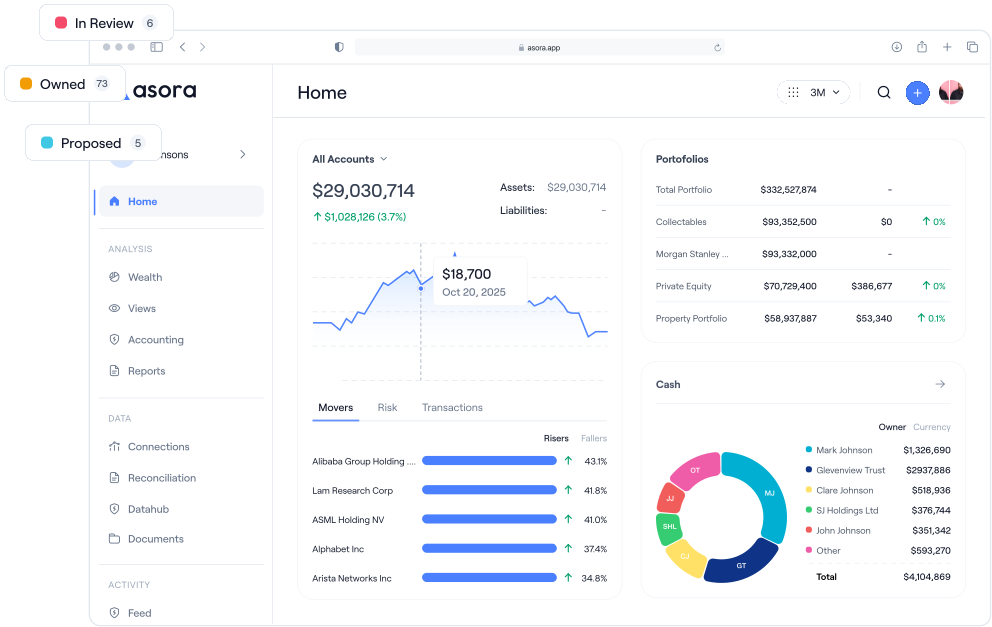

TL;DR
Running a successful single family office requires more than good intentions. These five single family office best practices form the foundation for preserving family wealth across multiple generations. Whether you're establishing a new office or refining existing operations, these principles provide a strong foundation for long-term success.
Build a Single Family Office That Lasts
For wealthy families looking to preserve wealth and manage assets across generations, a single family office provides a tailored solution that standard wealth management services can't match. But running a successful family office requires strategic decisions around governance, technology, talent, and careful planning.
Whether you're considering establishing a single family office or strengthening your existing operations, these single family office best practices will help position your office for long-term success. Let's explore the considerations that separate well-run family offices from those that struggle with wealth management issues.
5 Best Practices for Single Family Offices
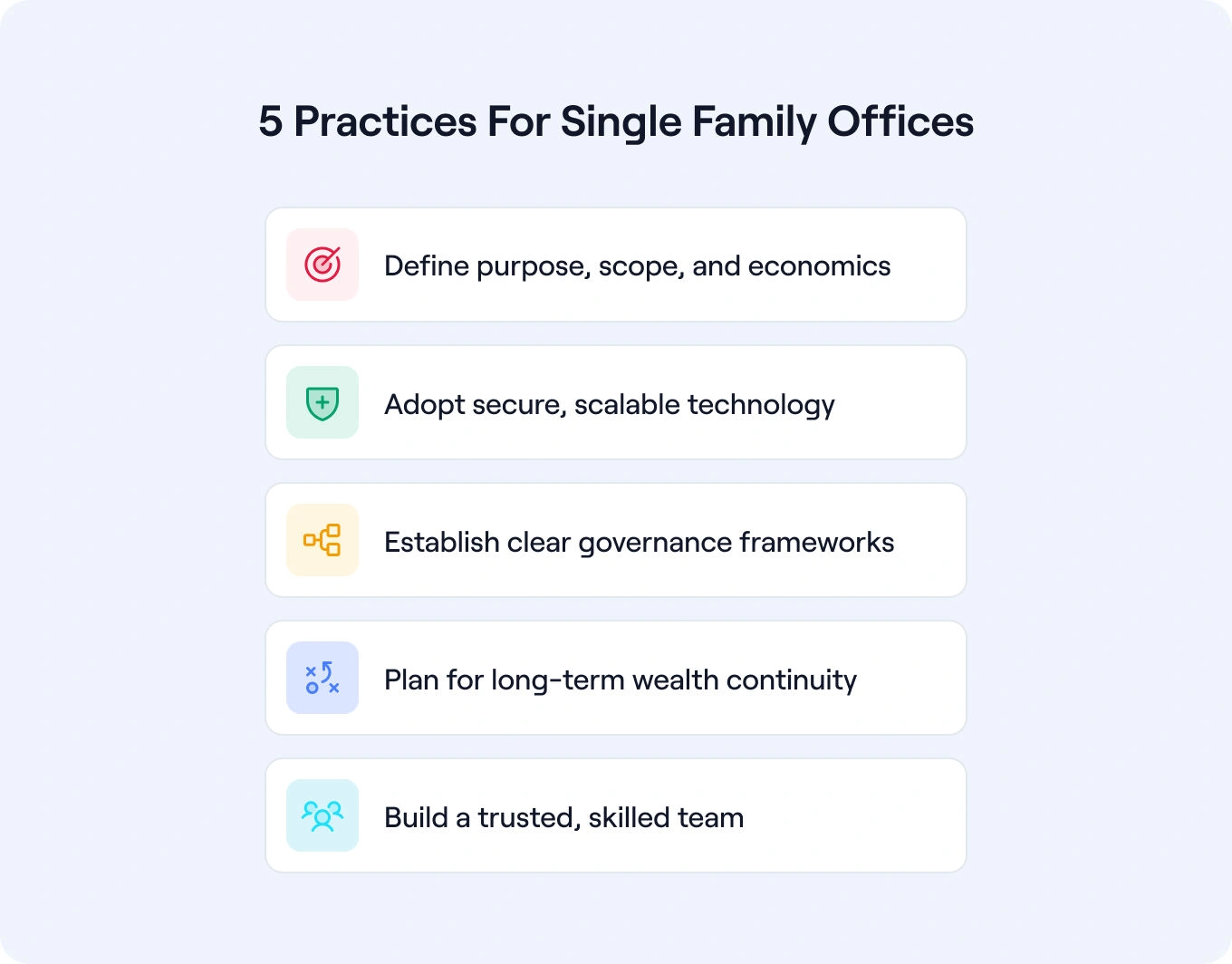
Use these five practices to standardize governance, tighten controls, and reduce spreadsheet sprawl and move toward more reliable, timely reporting. Treat them as a checklist to reduce risk, speed decisions, and build a resilient operation that serves the next generation.
1. Determine the Need and Purpose for Your Family Office
Evaluate whether you really need a family office.
- Confirm the underlying rationale, e.g., a significant liquidity event, growing portfolio complexity, or heightened privacy needs.
- Define the office’s scope: pure investment management or a broader remit (concierge, lifestyle advisory, property oversight, philanthropy).
- Validate that the asset base can sustain the required headcount and modern IT infrastructure.
- Benchmark against a multi-family office to assess cost, fit, and operational efficiency.
Define your family's mission statement. A clear purpose ensures your single family office structure aligns with the family's values, goals, and long-term legacy. Document the family's mission to guide decision-making and help future generations understand the office's role in wealth creation and wealth transfer.
Some families establish single family offices primarily for investment management services and asset allocation. Others build comprehensive operations covering estate plans, tax planning, risk management, legal and tax structures, charitable giving, and even health care coordination for family members.
Your family's unique circumstances should shape the office structure, not industry standards or what other families do. A thorough cost-benefit analysis comparing existing service models (private banks, wealth managers, multi-family offices) against a dedicated single family office will find the most appropriate path forward.
2. Leverage Technology for Efficiency and Security
Technology has become non-negotiable for modern family offices. Yes, that’s for operational efficiency, but also for data security and informed investment decisions.
Spreadsheets and manual tracking are increasingly insufficient for modern family wealth management, especially as portfolios and entity structures grow more complex. Today's single family office best practice is adopting family office software that handles:
- Data aggregation across multiple custodians, banks, and investment managers
- Portfolio management for both liquid and alternative investments
- Timely reporting that gives family members on-demand access to financial data
- Document storage with proper security protocols
- Automation of routine tasks like expense tracking and compliance reporting
Family offices face unique risks given their concentration of wealth and the information they hold about personal safety, asset locations, and family members' details. Your technology infrastructure should include:
- End-to-end encryption for sensitive data
- Multi-factor authentication for system access
- Regular security audits and penetration testing
- Clear protocols for working with third-party vendors
- Contingency plans for data breaches or system failures
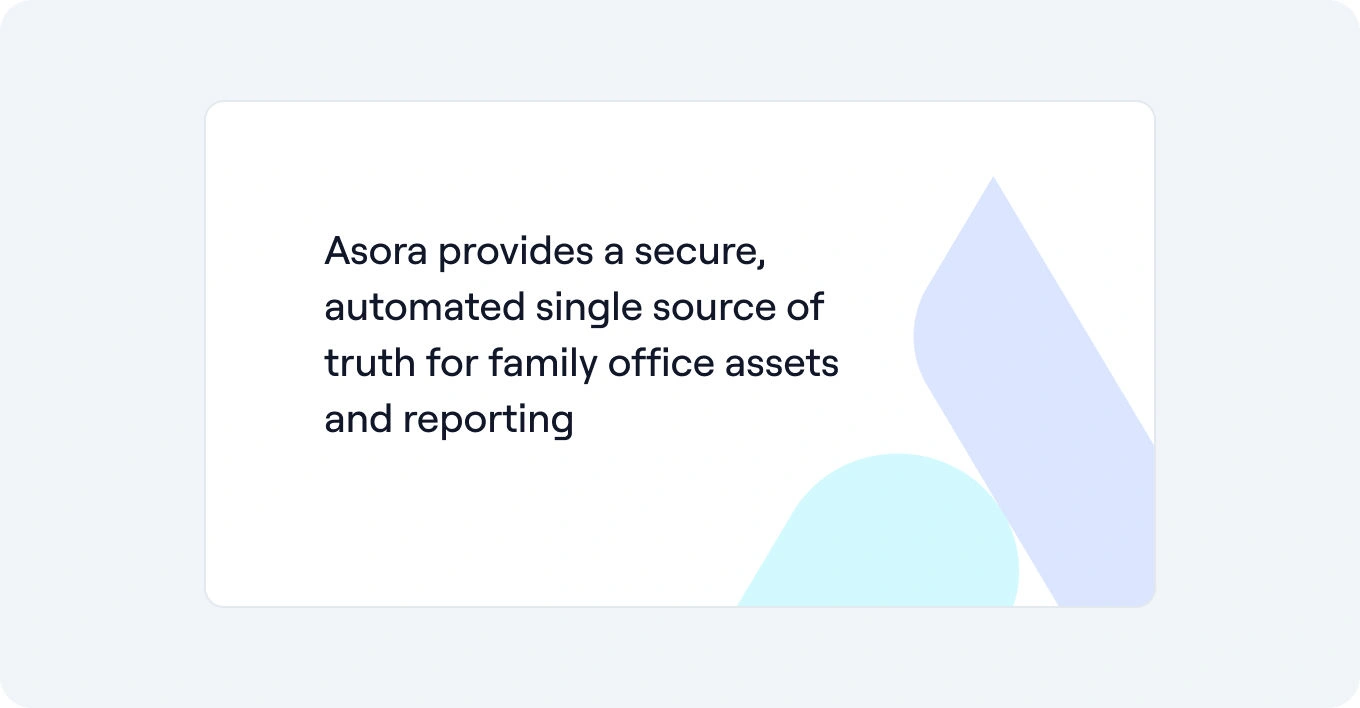
Asora helps single family offices track and oversee assets, automating data capture and offering secure, timely reporting through web and mobile platforms. The software provides a single source of truth for managing family wealth, aggregating data from banks and custodians.

3. Establish a Strong Governance Structure
Governance is the foundation of every successful single family office. Without a clear structure, even the wealthiest families struggle with decision-making, succession planning, and preserving the family legacy across multiple generations.
Elements of effective governance:
- Family charter or constitution : Document the family's mission, values, decision-making processes, and expectations for family member involvement. This becomes the operating manual that guides single family office executives and family members through both routine operations and major strategic decisions.
- Defined roles and responsibilities: Create clear job descriptions for office staff, family members involved in wealth management, and external advisors. Decide who makes investment decisions, who oversees legal structures, and how decisions about transferring wealth or charitable giving are made.
- Regular family meetings: Schedule structured gatherings, quarterly for operations, annually for strategic planning, where family members review performance, discuss the family's goals, and address emerging needs. These meetings create space for meaningful discussions about wealth, responsibility, and the family's long-term legacy.
- Succession planning: A successful family office prepares the next generation for stewardship responsibilities.
- Conflict resolution mechanisms: Families disagree. Governance structures should include predefined processes for resolving disputes about investment strategies, spending decisions, or family member involvement. Many families establish family councils or advisory boards that provide neutral guidance.
Strong governance reduces the risk of wealth fragmentation that typically occurs across generations. It helps ensure that the single family office structure serves the family's needs rather than becoming a source of family tension.
4. Focus on Long-Term Wealth Planning and Preservation
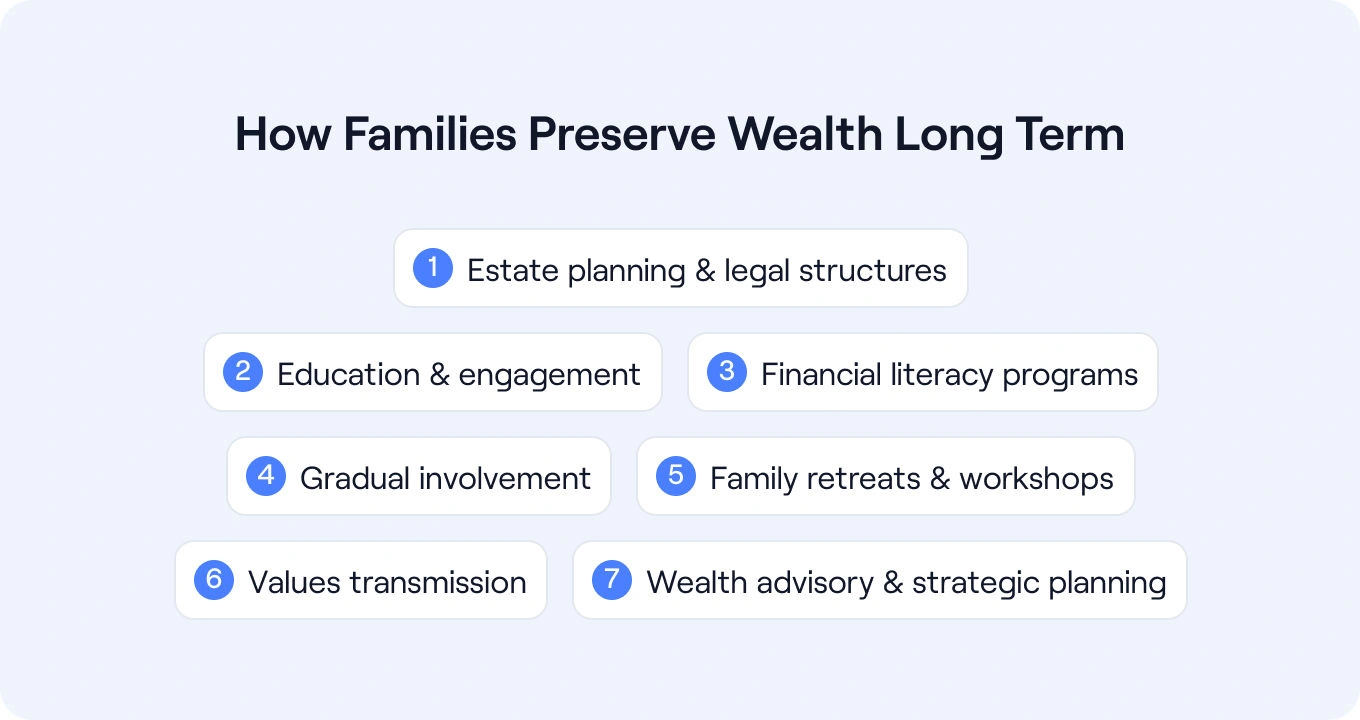
Preserving wealth across generations demands intentional planning for intergenerational wealth transfer and education of future generations.
- Estate planning and legal structures: Work with experts to establish appropriate tax structures.
- Education and engagement: One of the biggest threats to family wealth is unprepared heirs and weak family governance, often more damaging over time than market volatility. Successful family offices invest heavily in preparing the next generation:
- Financial literacy programs: Teach family members about investment strategies, asset management, risk tolerance, and the responsibilities that come with wealth.
- Gradual involvement: Bring younger family members into family office operations through internships, observation of investment committee meetings, or participation in philanthropic endeavors. Let them learn by doing, with appropriate guidance.
- Family retreats and workshops: Create regular opportunities for generations to discuss wealth management issues, the family's values, and individual family members' aspirations. These gatherings build connection and shared purpose.
- Values transmission: Help the next generation understand not just the mechanics of wealth management but the family's mission, what the wealth is for, not just what it's worth. This context makes them better stewards.
- Wealth advisory and strategic planning: Partner with experienced advisors who understand the unique challenges of intergenerational wealth transfer.
Ultimately, the goal is to create a family culture where wealth is understood as a tool for achieving the family's priorities and supporting future generations.
5. Invest in Talent and Expertise
Your family office is only as effective as the people running it. Building the right team is among the most crucial single family office best practices.
Core competencies to cover:
- Investment management: Whether in-house or through external managers, you need expertise in portfolio management, asset allocation across multiple asset classes, due diligence, and performance monitoring.
- Tax and legal: Specialists who understand complex legal entity structures, multi-jurisdictional tax planning, estate plans, and evolving regulatory requirements.
- Operations and administration: Professionals who can manage day-to-day operations, vendor relationships, technology systems, and reporting processes.
- Risk management: Experts who identify and mitigate risks, from cybersecurity to market exposure to personal safety concerns for family members.
- Family advisory: Some family offices employ professionals specifically trained in family dynamics, education, and governance facilitation.
Build or Buy Your Office Team?
The structure of a single family office determines whether you maintain all expertise in-house or rely on preferred providers for specialized services. Consider:
- In-house: Provides maximum control, confidentiality, and alignment with the family's unique needs. Requires sufficient scale to justify full-time roles.
- External advisors: Provide access to deep expertise in specialized areas at a lower full-time cost. Requires careful vendor management and clear service agreements.
- Hybrid approach: Many successful family offices maintain core functions internally (CIO, CFO, operations) while engaging external experts for specialized needs (tax preparation, legal work, specialized strategies).
Make a Built-to-Last Single Family Office
These single family office best practices provide a solid foundation, but remember: there's no universal blueprint. Your family's circumstances, values, and goals should shape every decision about your family office structure and operations.
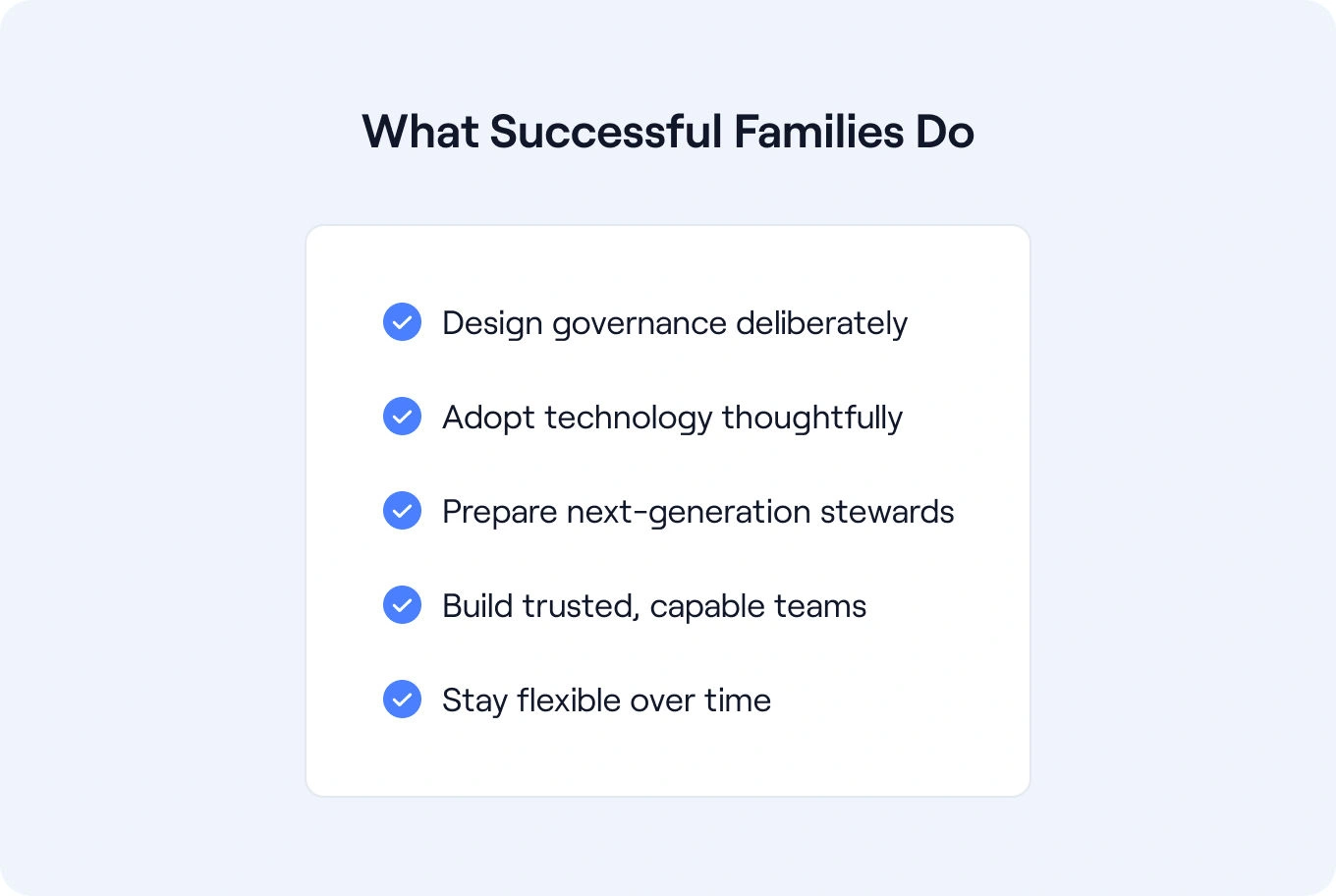
The families that succeed with single family offices are those that:
- Invest time in planning and governance design
- Embrace appropriate technology while maintaining personal relationships
- Prepare future generations for stewardship responsibilities
- Build teams with the right expertise and cultural fit
- Remain flexible as family needs and market conditions evolve
Want to see how technology can support your family office operations? Schedule a demo to learn how Asora provides secure, consolidated wealth tracking with timely reporting across all assets.
FAQ
What technology should single family offices use?
Adopt family office software that handles multi-custodian data aggregation, performance across all asset classes, secure document management, automated reporting, and timely visibility, backed by encryption, MFA, and regular security reviews. Asora provides consolidated wealth tracking, automated data capture, and secure reporting across web and mobile, helping lean teams replace spreadsheet sprawl with a single source of truth.
When should a family establish a single family office?
Families typically formalize an SFO when assets exceed $100–$250 million and needs outgrow standard providers, after a liquidity event, with rising complexity across entities and private assets, or when privacy and coordination become critical. Run a cost-benefit analysis against multi-family office options; if you proceed, a lean stack anchored by Asora can keep start-up costs in check while delivering the control and transparency you want from day one.
 ISO 27001 Certified
 GDPR Compliant