TL;DR
Private banking is a personalised banking relationship for high-net-worth clients: deposits, lending, credit facilities, and often basic investment products through a dedicated relationship manager. Wealth management is a broader advisory service that builds a long-term plan across investments, tax, estate planning, and often philanthropy. Private banking handles day-to-day banking. Wealth management designs the multi-decade plan. Many high-net-worth families use both, and the real operational challenge is keeping oversight when the private bank, external managers, and entities do not sit in one system.
Key takeaways
- Scope is the real split: private banking is banking-first; wealth management is plan-first.
- Typical private-banking entry is often around $1 million in investable assets or deposits, with mass-affluent tiers lower and UHNW tiers much higher.
- Wealth management fees are usually more transparent AUM charges (often ~0.5% to 1.5%); private banking costs often hide in lending margins and product economics.
- Fiduciary status is not automatic for private bankers. Ask how they are paid and which standard applies.
- Most complex families use both. The edge is consolidated reporting across the private bank and every external manager, which is the problem family office software is built to solve.
What is private banking?
Private banking is a personalised banking service for high-net-worth individuals, delivered through a dedicated relationship manager and focused on deposits, credit, lending, and related banking products.
Instead of the retail branch queue, you get a named banker who can arrange jumbo mortgages, securities-backed lines of credit, preferential deposit pricing, and, often, access to the bank's investment platform. The relationship is banking-first. The bank earns from balances it holds, loans it underwrites, and products it distributes.
What private banking typically includes:
- Dedicated relationship manager or private banker
- Current and savings accounts with preferential pricing
- Mortgages, Lombard or securities-backed lending, and other credit
- Basic investment products (often the bank's platform or funds)
- Introductions to trust, insurance, or estate teams inside the same group
What it often does not fully replace:
- Independent, open-architecture portfolio construction across many managers
- Family-level tax and succession design that sits above any single bank
- Multi-entity, multi-custodian consolidation for a family office
Private banks sit inside large groups (for example JPMorgan Private Bank, Citi Private Bank, UBS, Bank of America Private Bank, and regional private-client divisions). Many of those groups also run wealth-management arms, which is why the labels blur. Ignore the brand on the door and ask what the mandate is: banking convenience or whole-of-wealth advice. For how portfolio management differs from the planning layer, see asset management vs wealth management.
What is wealth management?
Wealth management is a holistic advisory service that combines investment management with tax, estate, retirement, risk, and often philanthropy planning in one long-term plan built around the client's goals.
Where private banking keeps the financial engine running day to day, wealth management is the route map: allocation, manager selection, liquidity for capital calls, estate transfers, and how the pieces fit across entities and generations. Providers range from independent RIAs and multi-family offices to bank-owned wealth teams and, at the top of the market, single family offices.
A typical wealth-management relationship covers investment policy and portfolio construction, tax-aware planning (with counsel), estate and succession coordination, insurance and risk management, and often philanthropy or next-generation education.
Fees are usually more explicit than private banking: an assets-under-management (AUM) fee is common, often around 0.5% to 1.5% of assets, with lower rates at higher balances. Some firms use flat planning fees, hourly work, or a hybrid. For how UHNW families run the full stack, see UHNW wealth management.
Private banking vs wealth management: at a glance
| Dimension | Private banking | Wealth management |
|---|---|---|
| Primary focus | Banking and transactions | Holistic financial planning |
| Typical services | Deposits, lending, credit, mortgages, basic investments | Investments, tax, estate, risk, philanthropy |
| Relationship | One dedicated private banker | Adviser or team (investments, tax, estate) |
| Time horizon | Immediate to short/medium term | Multi-year and multi-generational |
| Typical threshold | Often ~$1M (entry can be lower; UHNW tiers $5M–$10M+) | Often ~$250k–$1M+; comprehensive UHNW higher |
| Fee model | Lending margins, account fees, product economics, sometimes AUM | Explicit AUM and/or planning fees (often ~0.5%–1.5%) |
| Duty of care | Not always fiduciary; standards vary by role and jurisdiction | Often fiduciary (especially RIAs / fee-only) |
| How wealth is monitored | Bank statements, bank portal, product reports | Consolidated portfolio reporting, planning reviews |
| Best for | Liquidity, credit, and banking convenience | Growth, preservation, and transfer of wealth |
| Often delivered by | Private banks and private-client divisions | RIAs, wealth firms, MFOs, family offices, bank WM arms |
The differences that matter
Scope of services
A large credit facility secured on a securities portfolio is private banking territory. A plan that joins public markets, private equity capital calls, a next-generation trust, and tax across entities is wealth management, and at higher complexity it becomes family office work.
Banks increasingly sell both under one roof. The convenience is real; the independence still needs checking. Ask whether investment choices are limited to proprietary products and whether tax and estate work is full strategy or light coordination.
Relationship and team
Private banking is usually one banker as your door into the institution. Wealth management is often a lead adviser plus specialists. The private banker coordinates credit, deposits, and bank products. A wealth manager spends more time on allocation, managers, and life events such as a sale, inheritance, or cross-border move.
At multi-family office level, the team deepens further: investment, tax, estate, governance, and reporting staff shared across families. That is still wealth management in the broad sense, with more operating infrastructure than a classic RIA.
Fees and minimums
They are priced differently, so "which is cheaper?" is the wrong first question. Private banking costs often sit in lending margins, account or custody fees, product commissions, and optional AUM charges on assets managed inside the bank. Wealth management more often uses explicit AUM fees (commonly about 0.5% to 1.5%, near 1% at smaller balances and lower at scale), flat planning fees, or both. Fee-only models avoid product commissions.
Minimums, rule of thumb
- Private banking entry: often around $1 million in investable assets or deposits; some mass-affluent programmes start lower (for example mid six figures); exclusive or UHNW private-bank tiers frequently sit at $5 million to $10 million+.
- Wealth management entry: many firms from about $250,000 to $1 million; full UHNW programmes and multi-family offices often $5 million to $25 million+.
- Family office economics are a separate conversation: a single family office usually needs far larger scale (often discussed from roughly $100 million+). See SFO vs MFO.
These are industry rules of thumb, not guarantees. Every firm sets its own gate.
Time horizon
Private banking is built around current balances, credit, and near-term needs. Wealth management is built around multi-decade goals. Liquidity events, generational transfer, and philanthropy sit in the wealth-management frame. Private banking's tools (credit lines, deposits, bank products) serve a different clock.
Fiduciary duty
A fiduciary must put the client's interests first and manage conflicts carefully. Many independent wealth managers organised as registered investment advisers are held to a fiduciary standard under investment-adviser rules. Private bankers are employees of the bank. They may be subject to suitability or best-interest standards, product distribution incentives, or mixed roles depending on jurisdiction and registration. Incentives follow the employer.
Ask either side: Are you a fiduciary for this relationship, and under which rules? How are you compensated (salary, AUM, product sales, lending volume)? Will you recommend products outside your institution's shelf? Who owns the data, and can I export a full holdings file?
Where private banking and wealth management overlap
The lines have blurred on purpose. Large banks built wealth-management divisions so private-banking clients would not leave for independent advisers. Independent wealth managers partner with private banks so clients can still access sophisticated credit. Multi-family offices often keep several banks and managers at once.
Overlap is healthy when roles are clear: the private bank usually leads on securities-backed credit, cash, FX, and deposit pricing; the wealth manager or family office usually leads on strategic allocation, manager selection, and estate design with counsel. If one firm claims to do everything, still map who owns each decision and how conflicts are handled when bank products and external options compete.
When HNW families use both, and how they keep oversight
Many families end up with both, plus a way to see the whole picture.
A common operating model:
- Private bank holds cash, runs mortgages and Lombard facilities, and may custody part of the liquid book.
- External wealth manager(s) run public markets or specialist mandates under a fiduciary or advisory agreement.
- Alternatives (private equity, real estate, direct deals) sit with GPs, SPVs, or the family office itself.
- Tax and legal stay with independent counsel.
- Family office or principal coordinates capital, reporting, and governance.
The failure mode is predictable: each provider sends its own PDF, portal, and performance report. None shows total net worth after debt, multi-currency cash, capital-call obligations, and private marks. Principals end up reconciling in spreadsheets. That is a data problem, not a strategy problem.
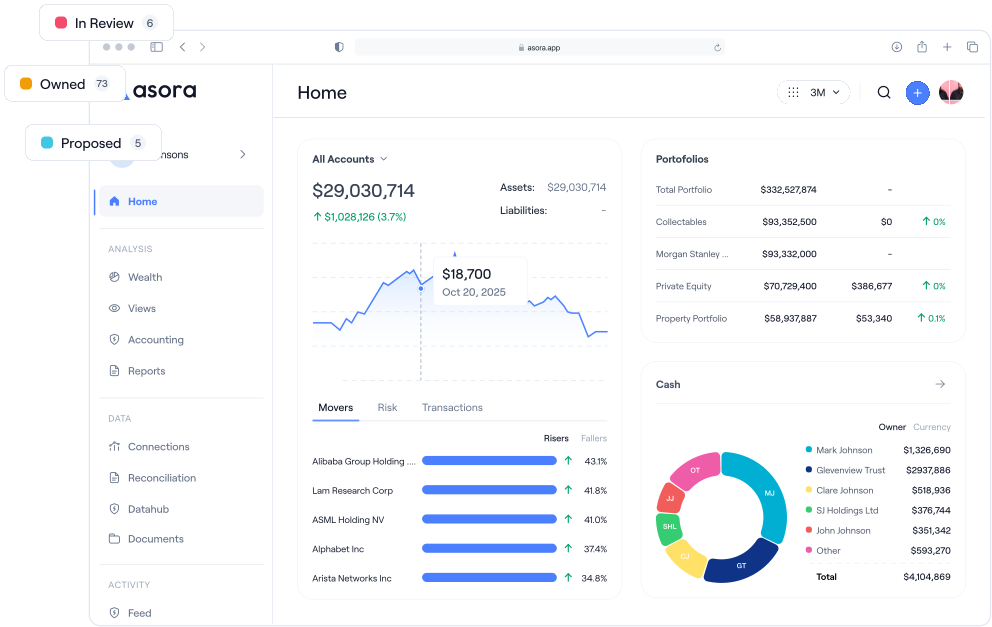
This is where purpose-built family office reporting software and wealth management software earn their keep: one live view of every bank account, manager, fund, and entity, so credit decisions and allocation decisions use the same numbers. Asora is built for that consolidation across SFO, MFO, and hybrid bank-plus-manager setups. For a wider market scan, see the best family office software guide.
How to choose
Use the questions below. If you answer "both" more than once, plan for a dual setup and invest early in consolidated oversight.
Banking-first
Lean private banking if
- Your main needs are credit, cash, FX, and high-touch banking.
- You already have (or want) outside advisers for tax, estate, and investments.
- You value one institutional relationship for liquidity and loans.
- You are comfortable with bank-platform investment products for a share of assets.
Plan-first
Lean wealth management if
- You need a full plan: investments, tax, estate, and goals over decades.
- You want open architecture and manager selection, not only one bank's shelf.
- Fiduciary, fee-transparent advice is a priority.
- Complexity is rising (entities, alternatives, cross-border, next gen).
Hybrid
Use both if
- You need bank credit and independent planning.
- Multiple managers already hold pieces of the portfolio.
- A family office or principal must report across everything.
- You refuse to run net worth from a pile of portal logins.
In one line: if the pain is banking friction, start with private banking; if the pain is strategy and coordination, start with wealth management; if the pain is "I cannot see the whole estate," fix reporting regardless of which label you hire.
Choosing well is only half the job
Private banking and wealth management are complementary. The right mix depends on liquidity needs, credit, complexity, and how much independence you want from any single institution.
What does not change is the operating requirement underneath: one trustworthy picture of assets, liabilities, and performance across every relationship. Whether you use a private bank, a wealth manager, a multi-family office, or all three, Asora consolidates accounts and managers into one live view so oversight stays with the family, not trapped in each provider's portal.
See a demo of how that consolidation works in practice.
FAQ
What is the difference between private banking and wealth management?
Private banking is a personalised banking relationship for high-net-worth clients: deposits, lending, credit, and often basic investments through a dedicated banker. Wealth management is a broader advisory service that builds a long-term plan across investments, tax, estate, and often philanthropy. Private banking solves day-to-day banking needs. Wealth management designs the multi-year strategy.
Do I need private banking or wealth management?
Choose private banking when your priority is credit, cash, and high-touch banking. Choose wealth management when you need a full plan for growing, protecting, and transferring wealth. Many high-net-worth families use both: a private bank for liquidity and lending, and a wealth manager or multi-family office for planning and portfolio oversight.
What is the minimum to qualify for private banking?
It varies by bank. Entry tiers often start around a few hundred thousand dollars in deposits or investable assets, with many private banks targeting roughly $1 million, and higher or ultra-high-net-worth tiers commonly from $5 million to $10 million and above. Always check the institution's published thresholds.
What is the minimum for wealth management?
Many wealth managers and RIAs work with clients from about $250,000 to $1 million in investable assets. Comprehensive or UHNW programmes often start higher, sometimes $5 million to $25 million or more when tax, estate, and multi-entity complexity rise. Family offices typically sit further up the scale again.
Is wealth management more expensive than private banking?
They are priced differently, so a single number rarely settles it. Private banking revenue often comes from lending margins, account fees, and product or AUM charges inside the bank. Wealth managers more often charge an explicit AUM fee, commonly around 0.5% to 1.5% (near 1% is a common midpoint at smaller balances, lower at larger ones). Compare total cost of advice, products, and credit, not just one line item.
Can you have both private banking and wealth management?
Yes, and many families do. A common pattern is a private bank for deposits, mortgages, and securities-backed credit, plus an independent wealth manager, multi-family office, or internal family office for strategy and reporting. The hard part is keeping a single, accurate view across every relationship.
Are private bankers fiduciaries?
Not always. Many private bankers work for the bank and may be held to suitability, best-interest, or product-sale standards rather than a full fiduciary duty to put your interests first at all times. Registered investment advisers (RIAs) and many fee-only wealth managers are typically fiduciaries under investment-adviser rules. Always ask how the person is paid and which standard applies.
How do family offices use private banks and wealth managers together?
A family office often keeps a private bank for credit and cash, and one or more external managers for public markets, alternatives, or specialist mandates. The office's job is coordination: capital calls, consolidated performance, tax packs, and governance. That only works when reporting is not trapped in each provider's portal.
.png)
.jpg)
 ISO 27001 Certified
 GDPR Compliant