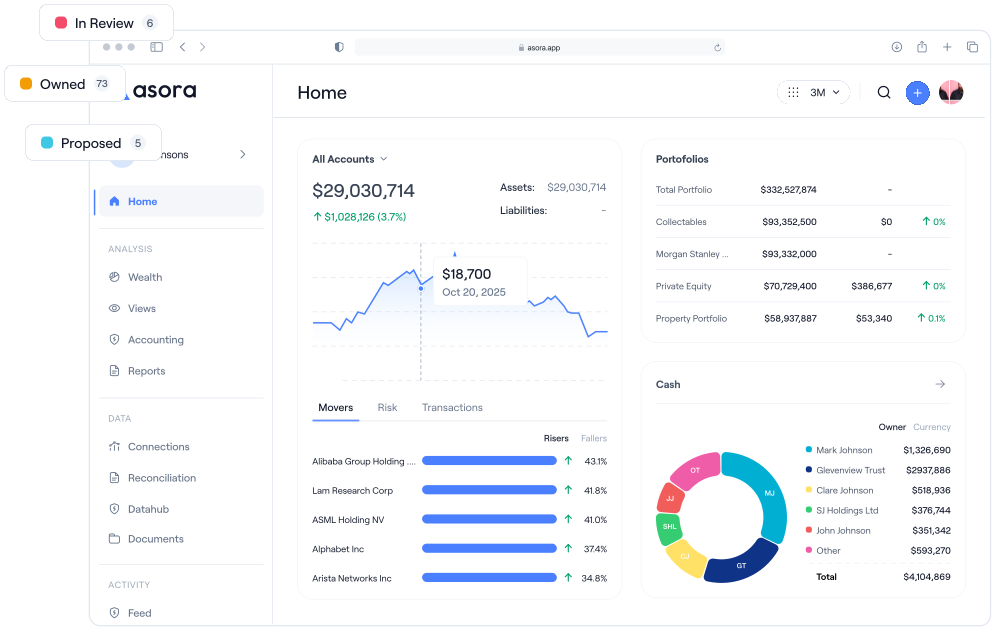
You built the wealth, someone has told you that you now need a family office, and you are trying to work out whether that is true and what to actually do first. This guide answers the question almost nobody answers in that order. Before you hire anyone, there is a family office software question, and getting the sequence right is the difference between a clean start and a two-year cleanup. The short version: software first, team later, because one is cheap and reversible and the other is expensive and hard to undo.
Do you need a family office, and what comes first
Here is the honest answer first. A full single family office, with its own staff, rarely makes sense below about $100 million, and it can cost $1 million or more a year to run. Below that, the right first move is not a team. It is software that puts your whole wealth in one place. That is the cheapest, most reversible decision you will make, and it is the one that should come first.
There is no single net-worth number, and the experts openly disagree. Dean Dorton says families over $20 million often benefit. Charles Schwab and J.P. Morgan put a single family office above $100 million, with a full eight-person office closer to $1 billion. The numbers contradict each other by 50 times, which tells you the threshold is the wrong question.
| Structure | Typical net worth | What it costs | What it needs first |
|---|---|---|---|
| Retail apps and a couple of banks | Below ~$5M | Low | A net-worth app (public markets only) |
| Self-run or embedded setup, software-first | ~$5M to $100M+ | Software, plus a few specialists | One consolidated view of everything |
| Multi-family office (shared team) | ~$30M to $100M | A shared team you pay into | Clean data to hand over |
| Single family office (own team) | ~$100M and up | $1M to $6M+ a year, mostly payroll | A platform the team adopts |
The useful line for a first-generation wealth creator is this: from roughly $30 million up, the answer is start with software and grow, not hire a team you may not need yet. Smaller is fine too, the point is to put the system in early.
The mistake first-generation creators make: hiring before the data is clean
The common path looks responsible and is backwards. A founder sells, gets told to build a family office, hires a CFO or signs with a multi-family office, and hands them a shoebox of custodian PDFs and a fourteen-tab spreadsheet. The new team then spends most of its first year just reconstructing the data, the thing the founder is paying a premium for, before it can do anything useful.
The better path is quiet and cheap. Stand up the consolidated data layer first. Get everything you own into one place. Then whoever you eventually hire inherits a clean system instead of a mess, and, just as important, you can actually judge whether you need them at all. Plenty of founders find that once they can see everything clearly, the urgent case for a full team is weaker than they were told.
This matters more for a wealth creator than for almost anyone, because you already know how this works. You built a company by running it on real numbers, with a real system, closed every month. Your personal wealth almost certainly has worse instrumentation today than your business did in its first year. You would never have run the company on a spreadsheet you updated by hand, so the question is why the wealth that company produced is run that way now.
What "complexity" actually means, the triggers that matter more than net worth
Net worth is a weak trigger. Complexity is the real one. These are the moments that break a spreadsheet, whatever the number on it:
- A liquidity event. You sold the company, and cash plus reinvestment decisions land overnight. This is the single most common trigger, and it is also the worst time to start from scratch. The first ninety days after a liquidity event set the tone for the decade.
- Concentrated or illiquid positions. Founder stock, private equity, direct deals, real estate. The stuff no retail app can hold and no spreadsheet tracks cleanly.
- Multiple entities and jurisdictions. Holding companies, trusts, cross-border exposure. Each one multiplies the reconciliation work.
- The family enters the picture. A spouse, the children, the first "where do we actually stand" conversation. The moment more than one person needs to see the wealth, informal stops working.
There is a tailwind underneath all of this. Cerulli projects around $124 trillion will pass between generations through 2048, and first-generation creators are the people building the structures that wealth flows through. Getting the foundation right early is not admin, it is the start of the transfer you will eventually make.
The research on founders specifically is sobering. Columbia Business School's study of entrepreneurs who sold, Life After an Exit, found that "the qualities that make a good entrepreneur are seldom the same ones that make a good investor," and that the smoothest transitions came from people who "sought out professional advice well in advance of the sale." The lesson is to build the view before the money lands, not after.
The first-generation playbook: what to put in place, in order
No source writes this sequence down, because every other page jumps straight to what a team costs. Here is the order that actually works.
- Consolidate everything you own, in one place. Liquid and illiquid, every entity, every account. This is the wealth map, the book of record, and it comes before any hire.
- Get a monthly view you actually read. One clear picture of what you have and how it changed. Not an institutional dashboard, a founder-readable answer.
- Build an audit trail. So that a future adviser, accountant or CFO can pick it up without an archaeology project, and so you can explain any number a year later.
- Only then decide on people. Self-run it, bring in a fractional or embedded CFO, use a multi-family office, or, eventually, build a single family office.
The reason the order matters is cost, and the numbers are stark. J.P. Morgan's 2024 Global Family Office Report found that family offices run from about $1.3 million a year at the median to $6.1 million for the largest, and the single biggest line is payroll. A team is a seven-figure, hard-to-reverse commitment. Software that automates the data aggregation is a tiny fraction of that, and if it is wrong you change it. So do the cheap, reversible thing first, and let it tell you whether you need the expensive, permanent one.
This is the whole "software before staff" idea in one line: the old way to build a family office was to hire people and have them figure out the systems. The modern way is to put the system in first, automate the painful parts, and add people only for work that genuinely needs a human.
When you do hire, do not waste the team you build
None of this is an argument against ever hiring. It is an argument for hiring well. The data foundation you built makes your first hire far more productive on day one, because they spend their time on judgment and strategy instead of rebuilding your records from PDFs.
What to look for in that first hire depends on your path. If you keep an operating company, the natural first move is often an embedded CFO, the company finance chief who also runs your wealth. If you have stepped back from the business, you may keep running it yourself with software and a few specialists, the self-running setup. Either way, the rule is the same: the software should survive the hire. You do not re-platform when the team arrives. They adopt what you already built.
How a first-generation creator should evaluate family office software
When you do compare options, the checklist is short. Good family office software for a wealth creator should:
- stand up in weeks, run by you or one person at first, with no operations team required
- consolidate liquid and illiquid in one place, custodian feeds plus capital-call documents
- give you a founder-readable monthly view, not a dashboard built for an investment committee
- keep a clean audit trail a future CFO or multi-family office can adopt
- grow from self-run today to a formal single family office later, without a rebuild
- price for one principal, and not punish you for adding a family member as a view-only user
- come with real human support
The thing to test before any of that is the wealth map itself: can the platform build your full picture first, every asset, owner, entity and account, before you start comparing features. That is the milestone that makes everything after it possible.
If you want the honest version of what you actually need to begin, we wrote a plain guide to the requirements, and the full shortlist of platforms sits in our 2026 family office software guide.
Where to start this month
You do not need to decide on a structure, a team, or a budget today. You need one thing: your whole wealth in a single, consolidated view you can read. That is the move you can make before any other decision, and it is the one that makes every later decision easier. It is also the cheapest and the easiest to undo, which is exactly why it should be first.
When the wealth or the family eventually gets more complex, the setup steps and the team question will be there waiting, and you will face them from a position of clarity instead of a shoebox of PDFs.
If a sale or a handover is on the horizon, it is worth getting the structure in early rather than in the rush. Talk to Adam about getting your wealth onto one system before you hire.
 ISO 27001 Certified
 GDPR Compliant