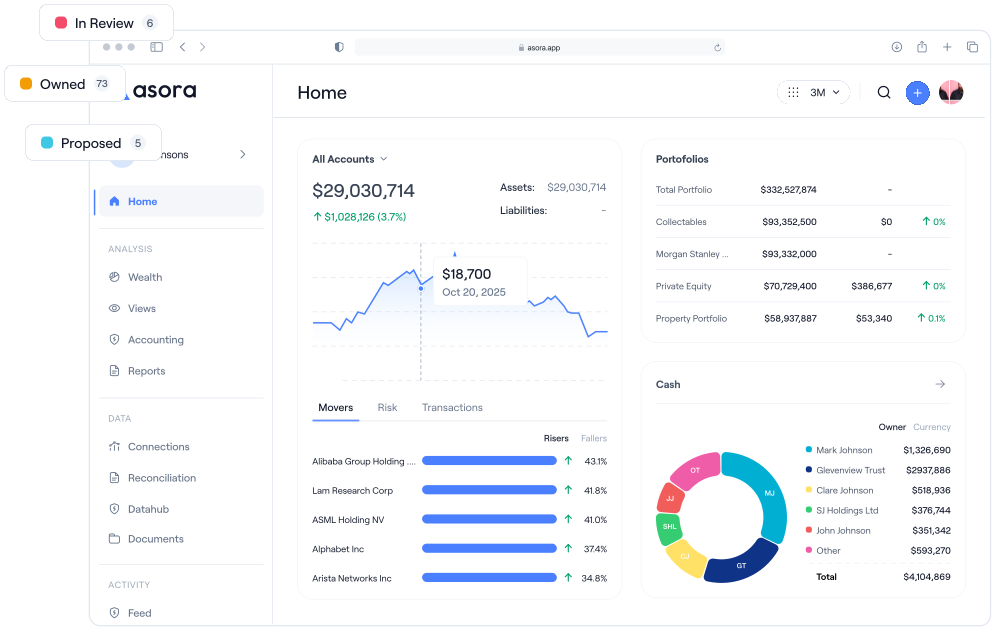
Almost everything written about the next generation is written for the people handing wealth down, or for the advisors selling to them. This is written for you, the inheritor. You are about to step into a family office, or you already have a foot in it, and the real question nobody hands you is how to tell whether the setup you are inheriting is actually well-run. The answer lives mostly in the software and the data. Here is how to read it, and the specific things to demand before you are the one holding it together.
The great wealth transfer, and why the software is your problem now
The numbers are real and enormous. Cerulli projects that around $124 trillion will pass between generations through 2048, most of it from the baby boomers, with the next generation set to inherit the largest share. It is the biggest handover of wealth in history.
Almost all of the conversation about it is emotional. Are the heirs ready, do they share the values, will they squander it. Those questions matter. But there is a second half that almost nobody covers, and it is the half that will actually land on your desk: the operational handover. Can the next generation see, understand, and run what they are inheriting on day one. That depends entirely on the family's software and data.
A thin handover is a real risk to the wealth, no matter how good the estate plan is. If everything you are inheriting arrives as a pile of PDFs, a spreadsheet only your parent understood, and a relationship with one bookkeeper, then you have inherited assets you cannot clearly see. That is not a values problem. It is a systems problem, and it is fixable, but only if you know what to demand before the handover, not after.
The handoff nobody plans for is operational, not emotional
You will hear that seventy percent of families lose the wealth by the second generation, and ninety percent by the third. It is repeated everywhere. It also does not hold up: when the researcher James Grubman traced the figure back, he found it came from a single 1987 study of manufacturing firms, about business survival, not wealth transfer, and concluded "there is no 70% rule." So ignore the folklore. The real, measured number is pointed in a different direction: only 19% of investors keep their parents' advisor, and more than 90% never even considered them. The handover of trusted people is fragile, which makes the system underneath it the thing that has to endure.
The standard advice for preparing heirs is all about values, governance and communication. All real, all necessary, and all silent on a simpler question: on day one, can you open one screen and see what you now own. The honest test is not whether you can learn the wealth, it is whether a system exists that lets you make sound decisions when the person who built it is no longer in the room.
The common reality is that the knowledge lives in one parent's head, one bookkeeper's spreadsheet, or one advisor's black box. When that person leaves, the next generation inherits assets it cannot see clearly. It shows up in the data: even among established offices, only about a quarter have a documented succession plan, according to UBS's Global Family Office Report. The gaps are predictable. technology that the next generation finds dated, weak engagement, thin preparation, and no succession plan for the office itself. Each one is a software and data question long before it is a feelings question.
The questions to demand right now, from your seat
This is the part no one writes for you. Here are the questions to ask while you still can, grouped by what they protect. Each one flips a quiet assumption into something you can verify.
Visibility
- Can I see the entire net worth, liquid and illiquid, in one place, today? If the answer involves three logins and a spreadsheet, that is your answer.
- Can I get the two numbers that matter on demand: what is our current net asset value and how did it change this month, and what obligations are due in the next thirty to ninety days?
Continuity
- If the person who runs this stepped away tomorrow, would anything break? Is the knowledge held in a system, or in one head?
- Could I locate a key document, a partnership agreement, a side letter, a valuation, in under five minutes? If not, the document map does not exist yet.
Control
- Whose name is on the software account? Can the family change advisors or bookkeepers without losing the data?
- Who can see what, and who decides? Are there written decision rights, or is it all informal?
Trust
- Is there an audit trail? Can I see how a number was calculated, not just the number?
- What are we paying, to whom, and what happens to our data if we leave?
If you read those carefully, you will notice they are not really questions about money. They are questions about whether a system exists. A well-run family office can answer all of them in an afternoon. One that cannot is one person away from chaos, however large the balance sheet looks. The goal is not to turn you into a chief financial officer. It is to make the information legible enough that you can act on it, and to surface the gaps now, while the person who knows the answers is still here to fill them in.
What "good" actually looks like
You are not the first generation to want this, and your expectations are different from your parents' by design. The research backs it up: CFA Institute's Next-Gen Investors study found that nearly 70% of younger investors who use an advisor want contact at least monthly, that they expect transparency on fees and conflicts, and that they "prioritize collaboration over delegation." You were raised with real-time information at your fingertips. A 2009-era portal that updates quarterly will not survive contact with you, and it should not.
So here is the simple diagnostic.
Green flags: one consolidated view that pulls everything together automatically; both generations can log in; a clear audit trail; the family owns the account; modern and actually usable.
Red flags: the critical numbers live in a personal spreadsheet; only one person can produce a report; an advisor "owns" the data; statements arrive as emailed PDFs; nobody under fifty has logged in this year.
The difference between the two lists is not sophistication or cost. A modest, modern setup that both generations can read beats an expensive institutional platform that only the departing bookkeeper understands. What you want is the family office equivalent of a system you could hand to a competent stranger and have them understand it in a week. If that is not what you are inheriting, that gap is the work, and naming it early is how you avoid inheriting it the hard way.
How to raise this without starting a family fight
This is the delicate part, because the moment can feel like an audit of the person who built everything. It does not have to.
Frame it as wanting to understand, not to inspect. "I want to understand what you built and how it works" is a very different conversation from "is this any good." Most founders are proud of what they made and happy to walk you through it, if the ask is curiosity rather than a challenge.
A software and data review is a useful way in, because it is concrete and low-stakes. You are not questioning anyone's judgment or values, you are asking to see the system, which is a practical, almost technical request. It opens the bigger succession conversation through a side door that does not feel like a confrontation.
And when the dynamic is hard, a neutral third party helps. An advisor both generations trust, or the structured onboarding of a software platform, can carry the conversation so it is not parent versus child. The system becomes the shared project rather than the battleground.
If you are inheriting soon, the first 90 days
If the handover is close, three moves give you control fast.
- Get everything consolidated into one view you can read. Before anything else, the full net-worth picture in a single place. You cannot manage, or even ask good questions about, what you cannot see.
- Map the key-person risks. Write down who knows what that is not written down anywhere else: the relationships, the passwords, the logic behind decisions. Every item on that list is a single point of failure you can fix while the person is still here.
- Decide what stays and what moves, before a transition forces your hand. Which advisors, which accounts, which tools. Choosing deliberately beats inheriting by default.
It helps to think of the year ahead in phases: first getting literate in what you own, then participating in decisions, then leading them. Good family office software is what makes that progression possible, because it turns "ask the bookkeeper" into "open the screen." If you are also the one who created the wealth rather than inheriting it, the order is the same from the other side, which we cover in the first-generation guide. The full picture of what a modern setup looks like is in our 2026 family office software guide.
Starting the conversation
You do not have to inherit the mess. The wealth that is coming to your generation is the largest in history, and the families that hold onto it will be the ones where the next generation could see and run what they received, not just receive it. That starts with a system both generations can open, long before the handover.
If you want the groundwork, our guide to preparing the next generation covers the operational side in depth. And when you are ready to get both generations onto one clear view, talk to Adam about what that looks like.
 ISO 27001 Certified
 GDPR Compliant