TL;DR
Asset management is the work of investing a portfolio (equities, bonds, funds, alternatives) to hit a return objective within a risk budget. Wealth management is broader: it usually includes investment management plus tax, estate, retirement, risk, and often philanthropy, framed around a person's or family's life goals. Asset management is the portfolio layer. Wealth management is the financial plan around it.
Firms and banks sometimes sell both under one roof, and industry research often groups them as "asset and wealth management." The client still needs a clear scope: portfolio management alone, or a full plan that may hire portfolio managers underneath it.
Most high-net-worth clients use both layers. A wealth manager or family office sets the plan; asset managers run specific sleeves. The hard part is keeping one accurate view of every manager, account, and entity.
Key takeaways
- Scope is the split: asset management grows the portfolio; wealth management runs the whole financial life.
- Institutional asset management (pensions, endowments, funds) is not the same product as a personal wealth plan, even when both invest in markets.
- Fees usually rise as the service widens: pure portfolio mandates often cost less than full wealth advice at similar AUM.
- Families commonly stack both: a plan layer on top, specialist managers underneath.
- Consolidated reporting is what makes multi-manager wealth readable. See family office reporting software.
If you are choosing between banks and advisers as well, see private banking vs wealth management. Private banking is the banking relationship. Asset management is the portfolio discipline. Wealth management is the plan that may sit above both.
What is asset management?
Asset management is the professional discipline of investing capital across asset classes to meet a stated return objective within a risk budget.
An asset manager (or investment manager) builds and runs portfolios of equities, fixed income, real assets, commodities, and alternatives. Clients can be:
- Institutions: pension funds, endowments, insurers, foundations, sovereign wealth funds, corporates
- Individuals and families: via mutual funds, ETFs, separately managed accounts (SMAs), or private mandates
- Intermediaries: wealth managers, multi-family offices, and family offices that outsource sleeves
Day-to-day work is portfolio construction, security or manager selection, rebalancing, risk control, and performance against a mandate or benchmark. Success is measured in risk-adjusted return, tracking error, liquidity, and mandate compliance, not in whether the client's estate plan is finished.
Institutional vs personal asset management
Institutional asset management is large-scale investing for professional clients. Mandates are large, reporting is formal, and the client is often a committee with an investment policy statement. Product factories (mutual funds, ETFs, hedge funds, private market funds) sit in this world.
Personal asset management applies the same portfolio craft to an individual or family account, without automatically including tax, estate, or family governance. A strong equity SMA is still asset management. It becomes wealth management only when someone coordinates the rest of the financial life.
Family offices sit in the middle: they may run asset management in-house (a CIO desk), hire external managers, or do both, while the office itself supplies the wealth layer. See UHNW wealth management for how that stack usually looks at higher complexity.
What is wealth management?
Wealth management is a holistic advisory service that integrates investment management with planning for tax, estate, retirement, risk, and often philanthropy into a long-term plan matched to a client's goals.
Where asset management optimises a portfolio, wealth management asks what the portfolio is for: retirement cash flow, a business exit, multi-entity ownership, education, charity, or transfer to the next generation. Providers include independent RIAs, bank wealth divisions, multi-family offices, and, at the top of the market, single family offices.
A wealth manager typically:
- Sets or oversees investment policy and overall allocation
- Selects and monitors asset managers or funds (or runs investments in-house)
- Coordinates tax and estate planning with counsel
- Plans liquidity for spending, taxes, and capital calls
- Addresses insurance, risk, and sometimes philanthropy or next-gen education
Investment management is usually inside wealth management. That is why people say asset management is a subset of wealth management for individuals. For institutions, there often is no "wealth" layer at all: only asset management.
Asset management vs wealth management: at a glance
| Dimension | Asset management | Wealth management |
|---|---|---|
| Primary focus | Portfolio performance and mandate fit | Whole financial plan and life goals |
| Typical services | Allocation, security/fund selection, risk, reporting on the book | Investments plus tax, estate, retirement, risk, philanthropy |
| Time horizon | Mandate-driven (often multi-year) | Multi-decade and multi-generational |
| Relationship | Portfolio manager / research team | Lead adviser plus specialists |
| Typical client | Institutions, funds, and individuals seeking investment expertise | Individuals and families needing integrated planning |
| Fee model | AUM (often ~0.25% to 1.5% by strategy; passive lower; alts may add performance fees) | AUM (often ~0.5% to 1.5%) and/or planning fees |
| Data and reporting | Mandate/fund performance, risk, and holdings | Consolidated net worth, entities, managers, tax packs |
| Best for | Growing and risk-managing a defined portfolio | Aligning money decisions with life and legacy goals |
| Often delivered by | AM firms, fund complexes, hedge funds, in-house CIO teams | Wealth firms, private banks' WM arms, MFOs, family offices |
Key differences
Scope
An asset manager answers one question: given this capital and this risk budget, how should it be invested? Everything outside that question stays exactly where it was. Tax, estate, liquidity planning and entity structure still need a named owner, and when nobody is named, the family owns them by default.
A wealth manager takes that coordinating role, then decides which mandates belong where. This is also the line to test a provider against. Where a firm sells "wealth management" that is really product distribution, the coordinating layer is missing. Ask for a written scope of services, not a brochure title.
Services and team
Asset managers are built around research, portfolio construction and trading. The work is done by a portfolio manager and analysts you will rarely meet.
Wealth managers are built around a lead adviser who knows the family and coordinates specialists: tax, estate, insurance, and whoever runs the money. At multi-family office scale those specialists are in-house and shared across families.
Fees
The bands in the table are the general answer. Two things make them misleading.
Rates tier down steeply with size: a 2025 Cerulli survey of 2,000 US advisers projects a 2026 average advisory fee of 1.06% at $750,000, 0.92% at $1.5 million and 0.66% above $10 million. A band means little until it is applied to your own balance.
And the advisory fee is only the top layer. Funds inside the portfolio charge their own, deducted from net asset value rather than invoiced, so it never appears on the advisory bill. The Investment Company Institute puts the 2025 US average at 0.40% for equity mutual funds and 0.14% for index equity ETFs. Ask for the combined number across the whole book, not the headline rate.
Who it is for
The question is who holds the coordinating role:
- Nobody needs to, so asset management. One pool of capital, tax and estate already owned elsewhere, success judged against a benchmark. The institutional case, and the family office CIO hiring a sleeve.
- A provider should, so wealth management. One relationship owns the plan rather than the portfolio, usually because entities, alternatives or the next generation are adding complexity.
- You already do, so both. Your office coordinates and hires specialists underneath it.
Or plainly: if the portfolio should work harder, start with asset management. If the financial life is fragmented, start with wealth management.
A worked example: the same $10M portfolio under each model
Take a family that has just sold a business, with $10 million to invest: $6M in liquid securities, $2M of private equity at current NAV, $1.5M in cash, and $0.5M of stock in the acquirer. Alongside it sits $3M of unfunded commitments the GPs can call over the next few years.
Model A: asset management only
They hire a manager for the $6M liquid book. It runs against a balanced benchmark, gets rebalanced, and reports monthly. That sleeve is in good hands.
Nothing else moved. The $1.5M of cash was never sized against $3M of calls, so a drawdown in a weak market forces a sale out of the $6M. The acquirer stock has no disposal plan and no tax owner. PE marks arrive quarterly in a different format, so nobody can state net worth on a given day. Estate structuring waits, and the exit year, the best planning year this family will get, closes.
Model B: wealth management coordinating asset management
A wealth manager or family office writes the policy first: target allocation, a cash buffer sized to the call schedule, a concentration limit that forces a decision on the acquirer stock, and risk limits. The $6M mandate still sits underneath, unchanged, still asset management. What changed is everything around it. Cash has a job. The stock has a deadline. Estate work starts while the planning year is open. One report shows liquid holdings, private marks and cash together.
Same $10M, different operating system.
Do you need both? How they work together
For institutions there is usually no wealth layer at all, only mandates. For families the two stack, in three parts:
- A coordinating owner sets policy, tax and estate context, and picks the manager roster. That is a wealth manager, a multi-family office, or the family office itself.
- Asset managers run defined sleeves against clear mandates.
- Custodians and banks hold the assets and lend against them.
Hybrid is normal. What fails is hybrid without one reporting spine: each manager's PDF becomes the source of truth for an afternoon, then contradicts the next one.
Why consolidated data underpins both layers
The reconciliation problem belongs to the coordinating owner alone. Every manager holds complete data on its own mandate and no reason to hold anyone else's, so none of them can produce the household view. If the problem is that you cannot see what you own, no choice of scope fixes it. That work sits at the top or nowhere, and it has to deliver:
- One view of public and private positions
- Capital calls and distributions next to liquid balances
- Multi-entity reporting for tax and governance packs
- Exportable data so the family owns the record
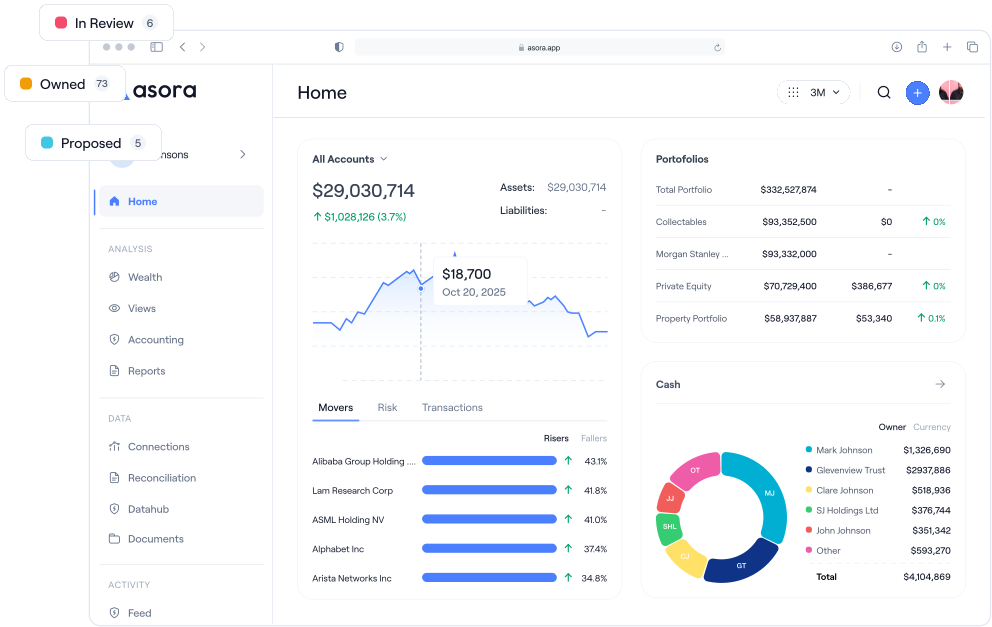
Wealth management software and family office software exist so nobody is reconciling five portals by hand, and for a market scan there is the best family office software guide. Asora consolidates every asset class and every manager into one live view, so the plan always sees what the portfolio desk is doing.
See a demo of that consolidation in practice.
FAQ
What is the difference between asset management and wealth management?
Asset management is the discipline of investing a portfolio of securities and other assets to meet a return objective within a risk budget. Wealth management is a broader advisory service that usually includes investment management plus tax, estate, retirement, risk, and often philanthropy, all aligned to a client's life goals. Asset management is the portfolio layer. Wealth management is the whole financial plan.
What does "asset and wealth management" mean?
Asset and wealth management, often shortened to AWM, is an industry umbrella term for firms and bank divisions that manage money for institutions and individuals. It covers both pure asset managers (funds, mandates, portfolio products) and wealth managers (holistic advice for people and families). People also use the phrase when they mean the combined stack: portfolio management sitting inside a broader wealth plan.
Is wealth management more expensive than asset management?
Often yes at the same AUM, because wealth management usually buys a wider team and planning stack, not only portfolio construction. Asset management fees commonly sit lower on pure mandates (often roughly 0.25% to 1.5% of AUM depending on strategy, with passive and large institutional mandates at the low end). Wealth management AUM fees are commonly around 0.5% to 1.5%, sometimes with planning fees. Always compare total cost, including fund fees inside the portfolio.
Do you need both asset management and wealth management?
Many high-net-worth families do. A wealth manager, multi-family office, or family office sets strategy, tax, and estate context, then hires or oversees asset managers for specific sleeves (public equities, fixed income, private markets). If your only need is professional investing and you already handle tax and estate elsewhere, pure asset management can be enough.
Are asset managers fiduciaries?
Often yes when they manage money under an investment-adviser mandate, but the standard depends on structure and jurisdiction. A registered investment adviser managing a discretionary account is typically a fiduciary for that advice. Mutual fund or product distribution roles can involve different duties. Always ask how the firm is registered, how it is paid, and whether it has a duty to put your interests first for the services you buy.
What services does a wealth manager provide?
A wealth manager typically coordinates investment policy and portfolio oversight, tax-aware planning (with counsel), estate and succession planning, retirement or liquidity planning, risk and insurance, and sometimes philanthropy or next-generation education. Many also select and monitor external asset managers rather than running every strategy in-house.
How do you evaluate an asset manager or wealth manager?
For an asset manager, review strategy fit, process, risk controls, fees, track record against the right benchmark, capacity, and operational quality. For a wealth manager, add planning depth, tax and estate coordination, fiduciary status, fee transparency, and the quality of consolidated reporting across accounts and entities. For either, insist on clear ownership of data and exportable holdings.
Is asset management only for institutions?
No. Institutional asset management serves pensions, endowments, insurers, and similar clients at large scale. The same discipline also serves individuals through mutual funds, ETFs, SMAs, and private mandates. Wealth management is almost always person- or family-centric. The confusion comes from using "asset management" for both the institutional industry and the investment sleeve inside a personal wealth plan.
.png)
.jpg)
.png)
 ISO 27001 Certified
 GDPR Compliant