
.png)
TL;DR
A multi-family office (MFO) is a comprehensive wealth management firm serving multiple wealthy families, sharing costs while providing personalized investment management, tax planning, and family governance services.
Wealthy families with substantial assets often need special services that go beyond what traditional management firms can provide. This is where multi-family offices come into the picture. While single-family offices have served one family exclusively, multi-family offices offer a unique approach by serving several families simultaneously. In this comprehensive guide, we explore what is a multi-family office, examining their structure, advantages, and how they differ from single-family office models in today's financial service industry.
Multi-Family Office Definition: What Is a Multi-Family Office?
The multi-family office definition encompasses a comprehensive wealth management firm that offers a range of services to multiple high-net-worth families. A multi-family office acts as a centralized hub that coordinates and manages various aspects of each family's financial affairs, including investment management, tax planning, estate planning, succession advice, and governance.
Multi-family offices are typically independent firms or divisions within larger financial institutions, serving a select group of high-net-worth families. The main objective of an MFO is to provide customized services tailored to meet the unique needs and objectives of each family it serves, while achieving cost-sharing benefits that make financial services more accessible than traditional single-family arrangements.
Multi-Family Office Structure and Organization in 2026
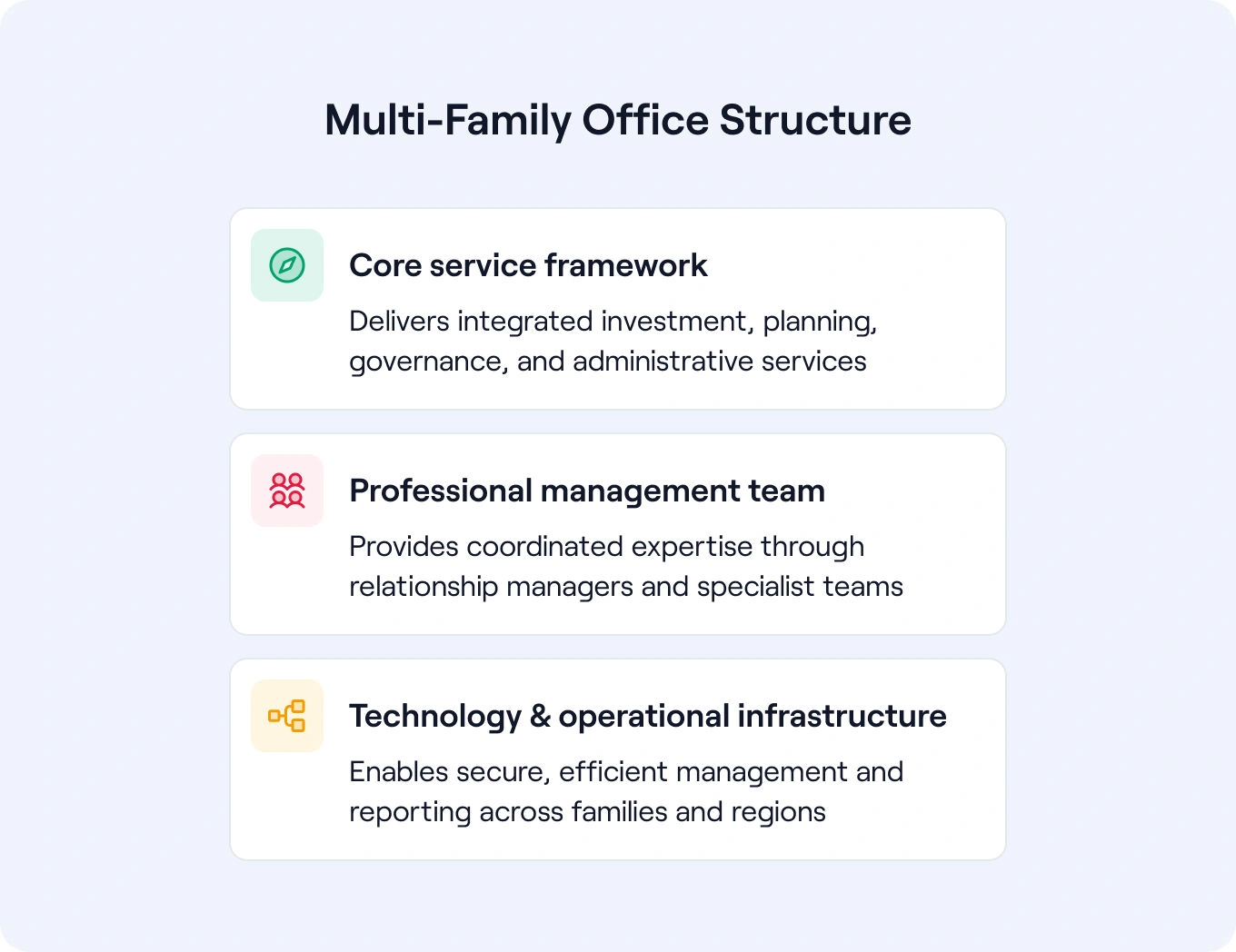
The structure of a multi-family office can vary depending on the specific needs of the families served. However, there are common characteristics found in most MFO organizations:
Core Service Framework
Multi-family offices offer services designed to address all aspects of managing wealth:
Investment Services:
- Portfolio management across multiple asset classes
- Strategy development and implementation
- Alternative investment opportunities including private equity and hedge funds
- Risk management protocols tailored to each family's wealth planning objectives
Tax and Financial Planning:
- Tax optimization and tax advisory services
- Tax services coordination with external tax advisors
- Financial advice for multiple generations
- Succession planning and wealth transfer strategies
Family Governance and Administration:
- Governance framework development
- Bill pay and lifestyle coordination
- Charitable giving program management
- Service delivery for family members
Professional Team Structure
Multi-family offices maintain dedicated teams of professionals:
- Client Relationship Management: Each family is assigned dedicated relationship managers who serve as the primary point of contact. These professionals understand each family's unique goals, coordinate service delivery, and ensure effective communication between family members and the MFO team.
- Investment Advisory Team: Registered investment advisors and professionals manage portfolios, develop strategies, and monitor financial markets to optimize investment opportunities.
- Specialized Support Network: MFOs maintain networks of financial advisors, legal experts, tax professionals, and estate planners to provide comprehensive solutions to complex financial challenges.
Technology and Operational Infrastructure
Modern family office operations rely on sophisticated technology platforms to manage families efficiently. The infrastructure includes comprehensive management systems, secure data management, and integrated reporting capabilities that serve families across different locations and time zones.
Multi-Family Office vs Single-Family Office: Key Differences
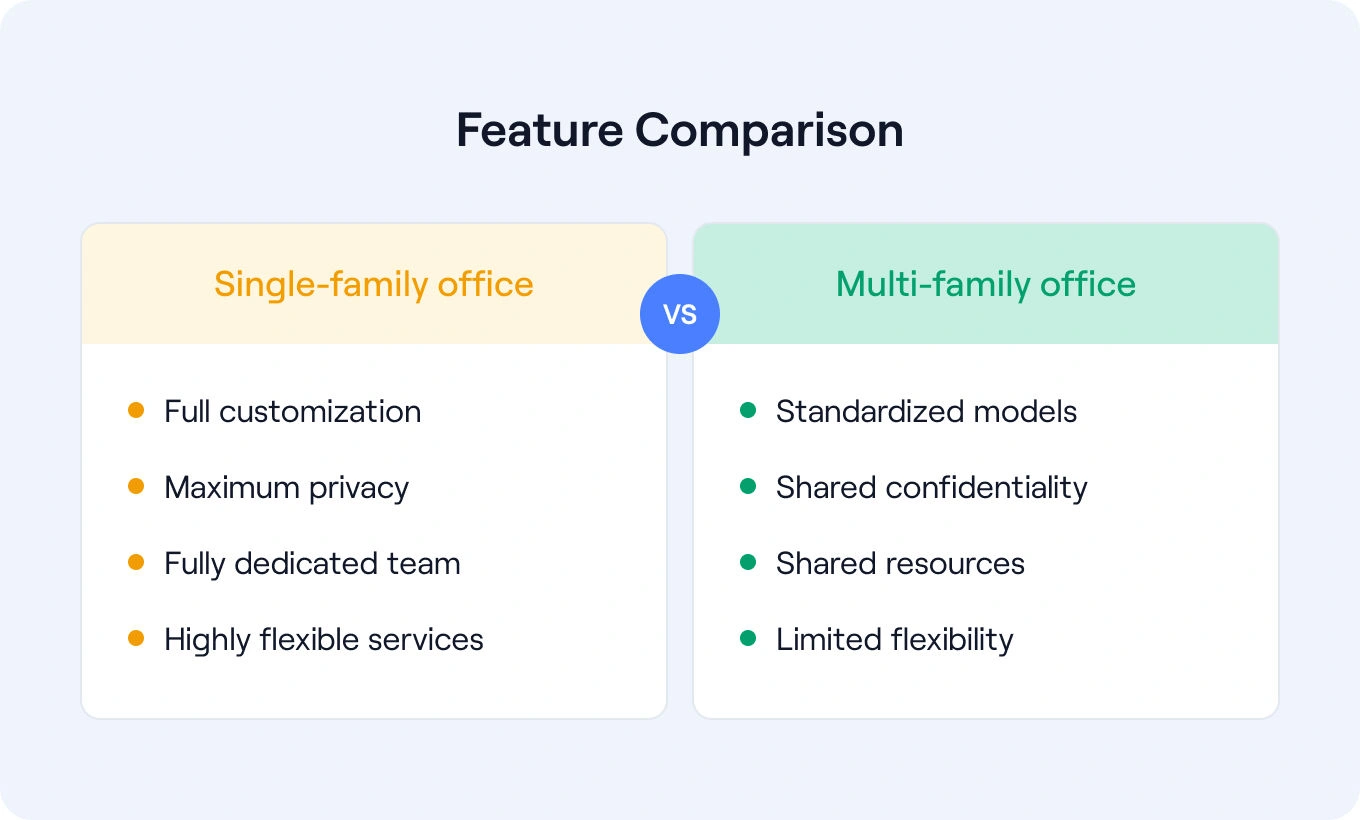
Understanding the differences between multi-family office and single-family office models helps families make informed decisions:
| Multi-family office (MFO) | Single-family office (SFO) | |
|---|---|---|
| Typical minimum wealth | $25–100 million | $100–500 million |
| Cost model | Asset-based fees, roughly 0.5–1.5% of AUM | All operating costs borne directly, often $1M+ per year |
| Team | Shared professionals across 10–50 families | Dedicated staff serving one family |
| Customisation | High, within a shared service framework | Complete control over strategy, staff, and systems |
| Privacy | Strong, with information barriers between families | Maximum; no other clients |
| Best for | Families wanting institutional service without overhead | Families with the scale and desire to run their own firm |
Client Base and Service Model
Multi-Family Office: Serves several families, typically 10–50 wealthy families, allowing for cost sharing and resource pooling while maintaining personalized service for each family's wealth management needs.
Single-Family Office: Dedicates all resources to one family, providing highly customized services but requiring higher net worth thresholds (typically $100–500 million) to justify operational costs.
Cost Efficiency and Fee Structure
Multi-family offices offer significant cost advantages through shared resources. While single-family offices require substantial investment in infrastructure, staff, and technology for one family, MFOs can pool resources among client families, making comprehensive services more cost-effective.
The structure in multi-family offices typically involves asset-based or combination fee models, whereas single-family offices bear all operational costs directly.
Collaboration and Knowledge Sharing
Multi-family offices promote collaboration among the families they serve, creating opportunities for:
- Joint investment opportunities and co-investment arrangements
- Shared experiences and best practices across families served
- Knowledge sharing on governance and succession planning
- Networking opportunities within the client community
Services Offered by Multi-Family Offices

Investment and Advisory Services
Multi-family offices provide comprehensive investment management encompassing:
- Portfolio Management: Diversified investment strategies across traditional and alternative asset classes, including private equity, hedge funds, and other tailored investment opportunities.
- Investment Advisory: Professional investment advice from registered advisors who monitor markets and identify optimal opportunities for multiple families.
- Risk Management: Comprehensive risk assessment and management protocols that protect family wealth while pursuing growth objectives.
Financial Planning and Tax Services
- Tax Planning: Sophisticated strategies that minimize tax liabilities while ensuring compliance across jurisdictions.
- Financial Planning: Long-term planning that addresses each family's unique objectives, from wealth preservation to multi-generational growth.
- Succession Planning: Comprehensive planning that facilitates smooth wealth transfer and prepares next generations for stewardship responsibilities.
Family Governance and Lifestyle Services
- Governance: Frameworks that engage family members across generations and preserve family values.
- Lifestyle Management: Personalized services including bill pay, property management, and coordination of lifestyle needs.
- Charitable Giving: Strategic philanthropy planning aligned with family values and tax benefits.
Advantages of Multi-Family Office Wealth Management

Cost Effectiveness
Many multi-family offices provide cost advantages compared to establishing a single-family office. By serving multiple families, MFOs achieve economies of scale that make comprehensive financial services accessible to families with lower net worth thresholds (typically $25–100 million).
Access to Expertise
Multi-family offices maintain larger teams of professionals, including specialists in various asset classes, tax advisory, and governance.
Diversified Investment Opportunities
Serving multiple families allows MFOs to access larger investment opportunities and negotiate better terms with managers and banks, benefiting all clients.
Reduced Administrative Burden
Families benefit from professional management of their financial affairs without needing to build internal teams, freeing them to focus on other priorities while ensuring expert oversight.
Modern Multi-Family Office Evolution
Technology Integration
Modern family office operations leverage advanced technology for portfolio management, reporting, and client communication, enabling more efficient service delivery to multiple families. Our family office software guide covers how these platforms fit both MFO and single-family setups.
Service Expansion
Many multi-family offices now offer lifestyle management, family education, and next-generation preparation programmes beyond traditional wealth management.
Global Reach
Multi-family offices increasingly serve families across jurisdictions, requiring expertise in international tax, cross-border investment, and global wealth planning strategies.
Selecting the Right Multi-Family Office
Evaluation Criteria
When evaluating multi-family office services, families should consider:
- Range and quality of services offered
- Experience serving families with similar needs
- Transparency and cost-effectiveness of fee structure
- Team expertise and credentials
- Technology capabilities and reporting quality
Due Diligence Process
Thorough research and due diligence are essential to find an MFO that aligns with your family's values and financial aspirations. This includes evaluating the firm's track record, client references, and cultural fit with your family's style.
Conclusion: The Multi-Family Office Advantage
The evolution of multi-family office wealth management continues to provide innovative solutions for families that need personalized service, professional expertise, and cost efficiency. Whether considering a multi-family office or comparing it to single-family office alternatives, the key lies in finding the right fit for your family's wealth objectives, values, and long-term vision for preserving and growing wealth across generations.
FAQ
How do multi-family offices maintain confidentiality when serving several families?
Multi-family offices implement strict confidentiality protocols and information barriers between client families. Each family's financial affairs remain confidential, with dedicated relationship managers and secure systems ensuring privacy while enabling cost-sharing benefits.
What services do multi-family offices typically offer beyond investments?
Multi-family offices provide services including taxes, estate planning, governance, succession planning, charitable giving, lifestyle management, and family education programmes for multiple generations.
How do multi-family offices charge for their services?
Multi-family offices typically use asset-based fee structures, often ranging from 0.5% to 1.5% of assets under management, though some may use hybrid models. The shared cost structure usually results in lower overall fees than establishing a single-family office.

.png)
.png)
 ISO 27001 Certified
 GDPR Compliant