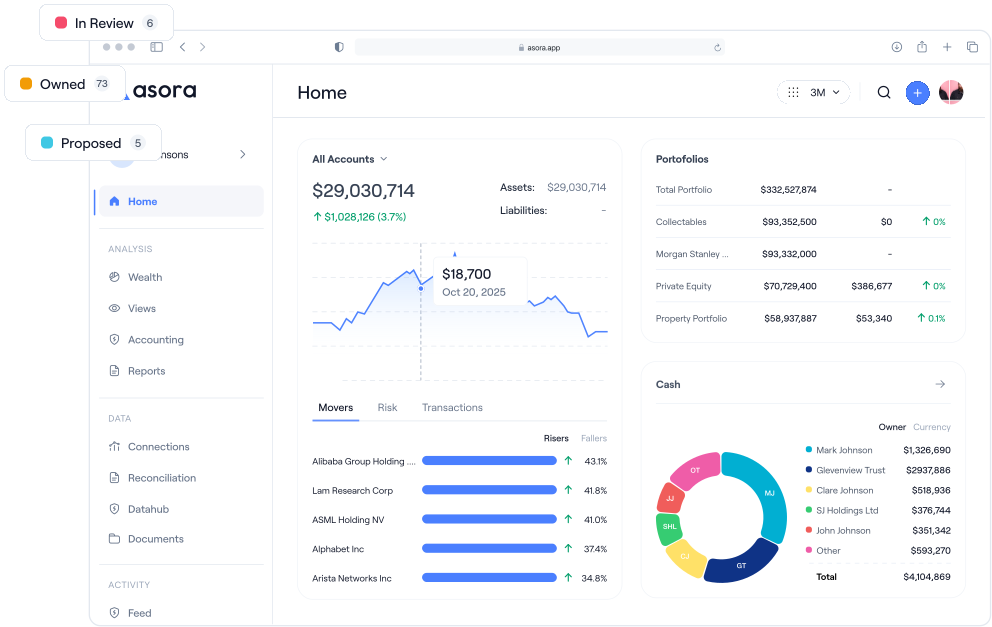
You built real wealth, you would rather run it yourself than hand it to an advisor or hire a team, and you want to keep it that way. That makes you a self-running principal, sometimes called a self-directed or micro family office. The trouble is that almost all family office software was built for a five-person back office, not for you. This guide is about the family office software that actually fits one person running their own wealth, and how to choose it.
What a self-running family office actually is
A self-running family office is when the principal personally runs the oversight of their wealth, the consolidation, the reporting and the decisions, using software and a few fractional specialists instead of a full-time team. It is sometimes called a self-directed or micro family office. The point is simple: you professionalize your wealth without hiring staff.
There is no single net-worth cutoff, but the widely repeated bands look like this:
| Setup | Typical net worth | Who runs it |
|---|---|---|
| Single family office (SFO) | ~$100M and up | A dedicated, full-time team |
| Multi-family office or outsourced | ~$30M to $100M | A shared team you pay into |
| Self-running or micro family office | ~$5M to $100M+, run lean (start early, grow with it) | You, with software and a few fractional specialists |
| Retail brokerage and net-worth apps | Below that | An app that only sees public markets |
In practice the typical self-runner sits around 50 million, stuck in what Adam calls no man's land: too big to just run a couple of bank accounts, too small to justify employees. The lean, software-first approach really earns its keep from about 30 million up, where a full team is hard to justify but a spreadsheet has stopped coping. You do not have to wait until then, though. Plenty of people put the system in early, with 5, 10 or 15 million the day after an exit, and let the platform grow with them. Starting early is the point, not a compromise.
You can have a family office even if you are worth 50 million and just do it yourself. You buy the software. A family office is anyone who professionalizes their wealth, not just the five-person, 600-million office.
That is the gap. Nearly all family office software is built and priced for a back office. You are neither a staffed SFO nor a retail brokerage customer, so your tooling ends up a patchwork of custodian portals, Excel and emailed PDFs.
Why most wealth software does not fit the principal who runs their own money
Retail net-worth apps stop at public markets
The consumer net-worth apps and brokerage dashboards are fine for stocks and funds. They fall apart on everything else you own: the private equity commitments, the capital calls, the building you bought, the stake in the company you just sold. For a self-running principal, that "everything else" is most of the wealth. An app that only handles tracking your net worth in public markets is tracking a slice of you, not the whole picture.
Enterprise family office platforms assume a team
At the other end, enterprise family office platforms like Masttro assume a controller and an operations analyst are logged in every day. You will not be. You want a clear answer once a month, not a second job keeping the system fed. Software built for a back office needs a back office to run it, and you do not have one.
You are the only user, and a busy one
There is no team behind you to chase statements, reconcile accounts or keep the data feeds alive. If the software does not do the heavy lifting on its own, it quietly stops getting used. The fear most self-runners arrive with is exactly this: that setting it up and keeping it going will eat a load of time they no longer have a secretary to absorb. So the honest test is not how powerful the platform is, it is whether it still works when nobody is babysitting it.
Control is the entire point
You chose to run your own wealth to keep control and privacy. Adam's model fits that exactly: you own the platform, and you bring your advisers onto it, instead of handing your data into someone else's system.
This is the platform. Bring your advisers in, but you own the platform. If you trust your tax adviser, just give them access. They can log in and have a look around every month.
Software that forces you to hand everything to an advisor defeats the reason you are here. And there is one line you will not cross: complex software that robs even more of your time. You want educated decisions and consultative conversations, not to end up buying something like Salesforce and getting stuck clicking around it.
What "managing your wealth like a business" actually requires
The do-it-yourself crowd online loves the phrase "run your wealth like a business." It is right, but it usually stops at the slogan. Here is the operational substance underneath it. A one-person wealth operation has to do five things well:
- consolidate everything in one place, liquid and illiquid
- track the private, illiquid assets alongside the public ones
- produce a monthly net-worth view you actually read
- keep an audit trail, so any number can be explained later
- stay ready for a tax or estate request without a fire drill
The honest part is the line between what you can self-run and what still needs a person. The software can do the consolidation, the tracking and the reporting on its own. The tax filing and the estate structuring still need a fractional specialist. Asora is the operating system for your wealth. It is not your accountant, and it does not pretend to be.
What a self-running principal's stack actually looks like in 2026
Here is the real toolkit a self-running principal is usually holding together. Not the polished version a vendor sells, the actual one.
| Layer | What you run today | The gap | What good looks like |
|---|---|---|---|
| Consolidation and tracking | Excel, plus a login for each bank and custodian | Manual, scattered, out of date fast | One platform that pulls the accounts together on its own |
| Private investments | Capital-call notices in your inbox, valuations in a spreadsheet tab | No structure, easy to miss a call | Private assets recorded, with documents linked to each one |
| Documents | Dropbox or Box | Not built to ingest a capital call or a statement | Documents attached to the asset they belong to |
| Reporting | The monthly net-worth picture you assemble by hand | Stale the moment it is finished | A net-worth view that updates itself |
| Specialists | A fractional CPA, an estate attorney, sometimes a fractional CFO | You hand them messy data and answer the same questions twice | Clean data they can pull from directly |
| Operating company, if you still own one | Sage or QuickBooks | A separate world from your personal wealth | Sits alongside, feeding the same picture |
The thing that makes this stack fragile is not any single tool. It is that the whole picture lives in your head, your inbox and a spreadsheet only you understand. The moment you are travelling, ill, or simply busy, nobody can answer the basic question: what do we have, and how is it doing.
When self-running stops working
Running your own wealth is not for everyone forever. The honest signal is not a net-worth cutoff, it is when the model starts to strain. A few real breakpoints:
- Complexity crosses a line. Multiple entities, multiple countries, trusts. When the structure itself becomes a full-time puzzle, you need help to run it, not just software to track it.
- A liquidity event hits. Selling the company multiplies both the money and the admin overnight, which is exactly when the first 90 days after a liquidity event decide how clean the next decade looks.
- The next generation joins. Once your children want their own view and their own say, a setup designed around one person stops fitting.
- Your time is worth more elsewhere. When the hours you spend on this cost you more than the help would, it is time to hand some of it out.
Notice what is not on that list: a net-worth number below which you should not bother. Adam does not believe in talking people out of running their own wealth.
I am firmly of the belief that everybody with money should have a book of record. If you are worth 30 million, you should have one. There are very few people who should not.
The one thing he asks for is effort. The software eases your life, but it is not zero work, and you still have to stay involved enough to keep it useful. When the breakpoints above do arrive, the path is a natural one: self-run, then bring in a fractional or embedded CFO, then, if it gets big enough, a formal single family office. The right software should carry you across each of those lines, not force a restart.
How to choose family office software when you are the one running it
Start with the wealth map, not the feature list. Before you compare anything, the first real step is to get your whole picture into one place: every asset, every owner, every entity, every account.
The first thing we do is build out the wealth map. Get your net worth in the system, every asset, every owner, every entity, every account. Then we connect your accounts and automate the information. Then we simplify.
Once your net worth is crystallized in a single system, you can judge the rest on its merits. Good family office software for a self-running principal should:
- build your full wealth map first, before any feature comparison
- be runnable end to end by one person, with no operations team
- go live in weeks, not months
- hold liquid and illiquid in one place, custodian feeds plus capital-call PDFs
- give you a report you can actually read, not an institutional dashboard
- keep you in control of your data, so you decide what each adviser sees
- grow from self-run to a formal single family office without a rebuild
- come with real human support, not a chatbot
- price for one principal, not a 20-seat enterprise contract
The mistake most people make is reaching for people first. The better order now is software first: get the data and reporting running, and add specialists later, for the valuable work, never for copying numbers between portals. When you are ready to compare options, our 2026 family office software guide lays out the shortlist.
When the self-running principal is ready for more
The day your wealth or your family gets more complex, the self-run model strains. The right software should carry you across that line, not force you to start over. The platform you ran yourself becomes the platform a fractional CFO, or eventually a small team, runs with you, with the same data and the same history.
You can have a piece of software for thirty years. Software does not age. An adviser retires, an employee moves on, but the platform endures.
For a decision you are making for the next thirty years, and probably for the next generation, that permanence matters more than any single feature. And if you would rather not open the dashboard at all, the direction we are building toward is a vetted partner who runs the setup for you while you still own the platform and stay in control.
If a liquidity event or a handover is coming, it is worth getting the structure in early. Talk to Adam about whether Asora fits a self-run setup.
 ISO 27001 Certified
 GDPR Compliant