TL;DR
A single family office (SFO) serves one family and is run by that family. A multi-family office (MFO) serves several families and shares its team and cost across them. Choose an SFO when you have the scale, usually $100 million or more, and want full control and privacy. Choose an MFO when you want institutional service without building and running your own firm, often from around $25 million. This guide compares the two on minimums, cost, control, privacy and services, and gives you a clear way to decide.
Key takeaways
- An SFO means total control, maximum privacy and a bespoke team, at a running cost that often starts at $1 million a year.
- An MFO means shared cost and instant expertise, for a fee of roughly 0.5% to 1.5% of assets, with less day-to-day control.
- The rough dividing line is wealth: $25 million and up suits an MFO, $100 million and up opens the door to an SFO.
- The choice is not permanent. Families move from MFO to SFO as they grow, and many run a hybrid of both.
- Whichever you pick, the structure is only as good as the data underneath it. One clean, consolidated view of every asset is what makes either model work.
Single family office vs multi-family office: at a glance
The short version: an SFO is your own private firm for one family. An MFO is a shared firm serving many families. Everything else, cost, control, privacy and staffing, follows from that one difference. The table below sets the two side by side.
| Dimension | Single family office (SFO) | Multi-family office (MFO) |
|---|---|---|
| Who it serves | One family only | Several families, often 10 to 50 |
| Typical minimum | From ~$100M (many say $250M+) | From ~$25M, some services lower |
| What you pay | Your own running costs, often $1M+ a year (~0.5% to 1%+ of assets) | A fee, usually ~0.5% to 1.5% of assets |
| Control | Total. You hire, set strategy, own the systems | Shared. You get oversight, not daily control |
| Customization | Fully bespoke | High, within a shared service model |
| Privacy | Maximum. No other clients | Strong, with barriers between families |
| Staffing | You build and manage the team | The firm's team, shared across families |
| Time to set up | Months to over a year | Weeks |
| Best for | Families with the scale and will to run a firm | Families who want the service without the overhead |
What is a single family office?
A single family office is a private company that manages the wealth and affairs of one family. It hires its own staff, sets its own strategy, and answers only to that family. Nothing is shared with anyone else.
An SFO does far more than pick investments. A full one handles portfolio management, tax, estate and succession planning, governance, reporting, bill pay, property and often philanthropy. In effect the family builds a small, dedicated firm. That is why scale matters: the cost of a real team, good systems and outside advisers only makes sense above a certain level of wealth. For the full picture, see our guide to what a single family office is.
What is a multi-family office?
A multi-family office is a firm that gives several families the same kind of service an SFO provides, while sharing the cost across all of them. You get a professional team and institutional-grade tools without hiring anyone yourself.
An MFO typically serves 10 to 50 families. Each family gets a relationship manager and access to shared specialists in investment, tax, estate planning and governance. Because the firm spreads its overhead across many clients, it can offer deep expertise to families who could never justify that team on their own. Read our full explainer on what a multi-family office is for how the model works in practice.
The differences that actually matter
Six things separate the two in real life. Read them in the order that matters to you.
Control and customization
An SFO gives you full control; an MFO asks you to delegate. In a single family office you choose the people, set the mandate, and change course whenever you want. Every policy is built around your family.
A multi-family office runs its own process and a standard investment approach that has to work for many clients at once. You keep oversight through reporting and governance, but you do not run the desk. For families who want to delegate, that is a feature, not a flaw.
Cost and minimums
An SFO costs more in absolute terms; an MFO costs less at the same level of wealth. A single family office carries the full weight of salaries, office, technology and advisers. A multi-family office turns that into a single fee because the cost is shared.
That is why the entry points differ so much. An MFO is realistic from roughly $25 million. An SFO usually needs $100 million or more before the running cost stops eating the return. The cost section below breaks the numbers down.
Privacy
An SFO is the most private structure there is; an MFO is private but not exclusive. With no other clients, a single family office keeps everything in-house. A multi-family office protects each family with information barriers and strict controls, but your affairs still live inside a firm that serves others. For families where discretion is the first priority, that gap decides it.
Talent and expertise
An MFO buys you a full bench on day one; an SFO means you have to build it. A multi-family office already employs specialists across asset classes, tax and governance, and you tap all of them at once. A single family office has to recruit and keep that talent, which is hard at the top end and a real management job in itself.
Speed to set up
An MFO is running in weeks; an SFO takes months to over a year. Joining a multi-family office is mostly onboarding. Standing up a single family office means hiring, choosing systems, setting up entities and writing policies before it does any real work.
Investment access
Both reach strong opportunities, by different routes. A single family office can pursue bespoke and direct deals that fit the family exactly. A multi-family office pools the assets of many families to reach institutional managers and better terms. Neither route is better on its own. The right one depends on how you want to invest.
How much wealth do you need for each?
As a rule of thumb: a multi-family office suits families from about $25 million, and a single family office starts to make sense from about $100 million, with many advisers pointing to $250 million before a full team pays for itself. These are guides, not gates. A family with unusual complexity might build an SFO earlier. A simpler family with more wealth might happily stay with an MFO.
Wealth thresholds, rule of thumb
- $25M to $100M: a multi-family office is usually the sensible home. You get the service without the cost of a team.
- $100M to $250M: either can work. The decision turns on control and privacy, not just cost.
- $250M and up: a single family office is fully viable. The running cost is a small share of assets, and control is often the deciding factor.
If you are near the lower end and unsure, a virtual family office is a third path: a lean core plus outsourced specialists, held together by software rather than a large payroll.
What each one costs
A single family office often costs $1 million or more a year to run. A multi-family office charges a fee, usually between 0.5% and 1.5% of the assets it manages for you. At the same level of wealth the MFO is normally cheaper, because the cost is shared. The example below is illustrative and will vary by country, complexity and service level.
| Annual cost for a family with ~$250M | Single family office | Multi-family office |
|---|---|---|
| Investment lead (CIO) | $300k to $600k | Included in the fee |
| Finance and operations | $150k to $300k | Included in the fee |
| Analyst and admin support | $100k to $250k | Included in the fee |
| Office, technology, legal, audit | $250k to $600k | Included in the fee |
| Total | ~$1.5M to $3M+ | ~$1.25M to $2.5M (0.5% to 1% of $250M) |
| As a share of assets | ~0.6% to 1.2% | ~0.5% to 1% |
The headline numbers look close at $250 million, which is exactly why control and privacy, not cost alone, tend to decide it at that level. Below $100 million the sums move firmly in the MFO's favour, because the fixed cost of an in-house team is spread over too little wealth. Our single vs multi-family office deep dive walks through more of the trade-offs.
The types you will actually meet
Neither term is one thing. Knowing the sub-types helps you compare like with like.
Single family offices usually fall into two shapes:
- Embedded SFO: the office sits inside the family's operating business or holding company and shares its staff and systems. Cheaper to start, less independent.
- Standalone SFO: a separate legal entity with its own team, premises and technology. More costly, fully dedicated, easier to hand to the next generation.
Multi-family offices come from several roots, and the origin shapes the service:
- Independent MFOs: built from the ground up to serve families, usually the most flexible on advice.
- Bank or private-bank owned: deep balance sheets and product, but watch for pressure to use in-house products.
- Accounting or law-firm affiliated: strong on tax, structuring and compliance.
- Evolved from an SFO: a family office that opened its doors to a few other families to share cost. Often very operator-minded.
When a single family office makes sense, and when a multi-family office does
Use the two profiles below as a quick filter, then pressure-test with cost and control.
SFO
Choose a single family office if
- You have roughly $100M or more, and control is a top priority.
- Your affairs are complex: operating businesses, direct deals, many entities or jurisdictions.
- Privacy is non-negotiable and you want no other clients in the room.
- You are willing to run a small firm, or hire someone to run it for you.
MFO
Choose a multi-family office if
- You have roughly $25M or more and want professional service without the overhead.
- You would rather delegate the day-to-day and keep oversight through reporting.
- You value a full bench of specialists on day one over a bespoke in-house team.
- You want to be running in weeks, not a year.
Can you switch, or run both?
Yes to both. The two models are points on a line, not a fork you can never leave. The most common path is to start with a multi-family office, then build a single family office as wealth and complexity grow. Some families run a hybrid: an in-house team for the parts they want to control, and an MFO or specialist providers for the rest. Deciding once and for all is the wrong frame. Pick what fits now, and keep the option to change.
If setting up is on your mind, our guide on how to start a family office covers the steps, and the family office structure guide covers the legal wrappers behind each model.
The one thing both structures depend on
Whichever model you choose, it only works if the numbers are right. An SFO with total control still fails if its data lives in a dozen spreadsheets. An MFO serving fifty families cannot report clearly if every custodian feed looks different.
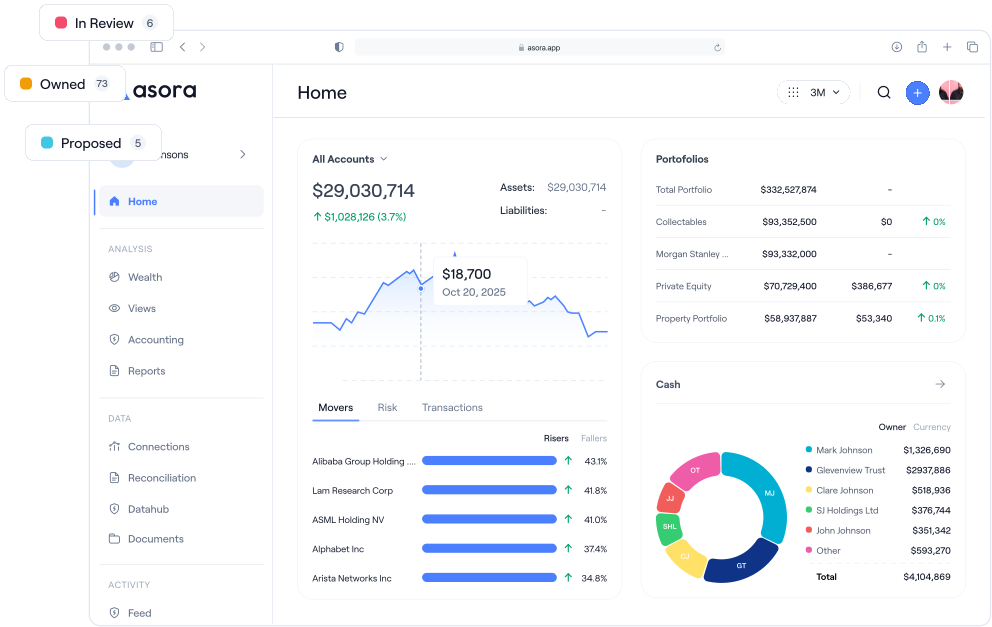
That is the problem Asora solves. It pulls together every account, entity, currency and asset class, public and private, into one live picture, so a single family office sees its whole position and a multi-family office moves between client families without losing its place. The structure is the shell. Clean, consolidated reporting is what makes it run.
FAQ
What is the difference between a single family office and a multi-family office?
A single family office (SFO) serves one family and is fully controlled by that family. A multi-family office (MFO) serves several families and shares its team and costs across them. An SFO gives more control and privacy at a higher cost. An MFO gives institutional service at a lower entry point, with less day-to-day control.
How much money do you need for a single family office vs a multi-family office?
As a rule of thumb, a single family office starts to make sense from around $100 million in assets, and many advisers put the figure closer to $250 million before a full in-house team pays for itself. A multi-family office is open to families from roughly $25 million, and some modular services start lower. These are guides, not hard limits.
Is a multi-family office cheaper than a single family office?
Usually, yes, at the same level of wealth. A multi-family office spreads the cost of staff, systems and research across many families, so you pay a fee of roughly 0.5% to 1.5% of assets instead of funding a whole team yourself. A single family office often costs $1 million or more a year to run, which only a large asset base can absorb.
Can you switch from a multi-family office to a single family office?
Yes, and many families do. It is common to start with a multi-family office, then build a single family office later as wealth and complexity grow. Some families keep both: an in-house team for control, and a multi-family office for services they do not want to staff.
Which gives you more control, an SFO or a multi-family office?
A single family office gives you full control. You hire the team, set the strategy and own the systems. A multi-family office gives you oversight and reporting, but the firm sets its own processes and standard investment approach, so you delegate the day-to-day.
Is a single family office more private than a multi-family office?
A single family office is the most private option, because it has no other clients. A multi-family office keeps strong confidentiality with information barriers between families, but your data still sits inside a firm that serves others.
Can a family use both a single family office and a multi-family office?
Yes. A single family office can buy in services from a multi-family office or specialist providers rather than hire for everything. This hybrid model keeps control over the parts that matter most while sharing the cost of the rest.
Which performs better on investments, a single or multi-family office?
Neither structure wins on its own. Investment results depend on the quality of the team and the governance around it, not on the label. A single family office can chase bespoke and direct deals, while a multi-family office pools access to institutional managers.

.png)
.png)
 ISO 27001 Certified
 GDPR Compliant