If you are the CFO of an operating company and you also keep track of the owner's personal wealth, you are an embedded CFO, running what the industry calls an embedded family office. Most people in the role never use that term. You just know that on top of your real job, you are the one who tells the founder what they are worth, and you are almost certainly doing it in a spreadsheet. This guide is about the family office software built for that job, and how to choose it.
What an embedded CFO actually does
An embedded CFO is the finance chief of an operating company who also runs the owner's personal wealth, without a separate family office team. The reporting, the cash tracking, the consolidation: it all sits inside the business and lands on one person's desk as a second job. It is the most common way a wealthy founder's money gets managed before anyone builds a dedicated office.
They have an operating business, they are generating a lot of wealth from it, and it gets to the stage where it has to be managed. The CFO is the obvious person. So the CFO starts doing it on the side. That is an embedded family office: you have embedded it in the operating business.
This is usually a first-generation story. By the second or third generation the wealth has typically been spun out into its own office. And it is CFO-led, which means it is built around finance, accounting and cash, not around investment management. The person doing it is the founder's right hand, the numbers person who helped build the company, not a portfolio manager.
That last point matters for software. Almost every wealth platform is built for one of two readers: a large single family office with its own staff, or a multi-family office serving many clients. The embedded CFO is neither. So the tooling ends up a patchwork of the operating-company system and a growing spreadsheet.
Four problems no family office software solves for the embedded CFO
The business and the family are two different things, and you touch both
Your operating company and the family's holding structure are not the same entity, but you are the one person who sees inside both. Software built for a single family office assumes a clean family entity tree and nothing else. Your operating-company accounting system, Sage Intacct or NetSuite, assumes you never touch personal wealth. Neither one was built for the person standing in the middle, so you end up copying numbers out of one world and into a spreadsheet that tries to be both.
You are the whole finance team
A real single family office has a controller and an operations analyst who log in every day. You do not. You have your day job, and then you have this. As Adam puts it, the pain is simple: this is not your primary job, it is your secondary one, and you still feel the duty to report on it well, but you do not have the time. Most enterprise platforms, Masttro among them, are designed for that daily back office. If the software needs a team to run it, it will not get run, because you are the team and you are busy.
Cash, private deals and property, all in one pair of hands
You know where every euro is. The company's cash position, the owner's brokerage account, the private equity commitments, the building they bought last year. As a CFO you are wired for cash and treasury first, so the part that really bites is tracking and monitoring every bank account by hand. Good software has to pull the liquid accounts automatically and still hold the private, illiquid things, without a six-week onboarding to get there.
There is one reader, and it is the founder
The monthly report is not for an investment committee. It is for one principal who wants a clear answer to a simple question: what do we have, and how is it doing. Dashboards built for institutional investors are over-engineered for an audience of one. The job is a clean monthly view the owner can actually read, not a wall of analytics nobody opens.
When the embedded model stops working
Embedded is not a failure mode. For a lot of families it is the right setup, and the honest question is how to run an embedded family office well, without letting it become a distracted, second-class version of the real thing. But it is a stepping stone, not the destination.
What decides when to graduate is relative wealth, not a single number. The rule of thumb: while most of your wealth still sits in the operating business and there is one generation, stay embedded and do your day job. If the business is worth 300 million and you have 30 million outside it, you are managing the 30 on the side, and that is fine. The moment a large share of your wealth sits outside the business, or moves into the next generation's name, or you have several beneficiaries across two generations, the picture flips. When you have 150 million outside and the business is worth 100, the wealth is now the bigger job, and it deserves its own office.
The graduation test
Plot two things: how much of your wealth sits outside the operating business, against how many beneficiaries and generations are involved. High on both, build the independent single family office. Low on both, stay embedded and do not get distracted.
There is a bigger shift underneath this. Families used to hand down the operating business itself, generation after generation. Today the business is far more likely to be sold, or bought by private equity, so what gets handed down is a pot of money and the structures around it. The family office becomes the family business. And a family business needs real reporting and real systems, not a spreadsheet only one person understands. If a sale is twelve to twenty-four months out, the time to put structure in is now, not in the rush of the first ninety days after a liquidity event.
What an embedded CFO's stack actually looks like in 2026
Here is the honest picture of the tools an embedded CFO is usually running. Not what a software vendor wishes it looked like, the real thing.
| Layer | What you run today | The gap | What good looks like |
|---|---|---|---|
| Operating-company books | A proper ERP: Sage Intacct, NetSuite, Xero or QuickBooks | Built for the business, blind to personal wealth | Stays as is; the wealth platform sits alongside it, not on top |
| Personal wealth tracking | Excel, custodian portals, emailed PDF statements | Manual, fragile, grows every month | One platform that aggregates the accounts on its own |
| Cash and bank accounts | Logging into each bank and copying balances | No live view, easy to miss a movement | Bank feeds that track every cash account automatically |
| Private investments and property | A spreadsheet tab, capital-call notices in an inbox | No structure, no audit trail | Private assets recorded with documents linked to each holding |
| Documents | Dropbox, OneDrive or Box | Not built to ingest a capital call | Documents attached to the asset they belong to |
| Tax | The CPA's system: Drake, UltraTax or CCH | Stays outside, but needs clean data handed to it | Records the tax adviser can pull from without chasing you |
| Reporting | Hours in Excel every month | Out of date the moment it is finished | A monthly net worth view that builds itself |
The split down that middle column is the whole problem. You run the operating business on a real system and the family's wealth on a spreadsheet, and you would never accept that gap inside the company.
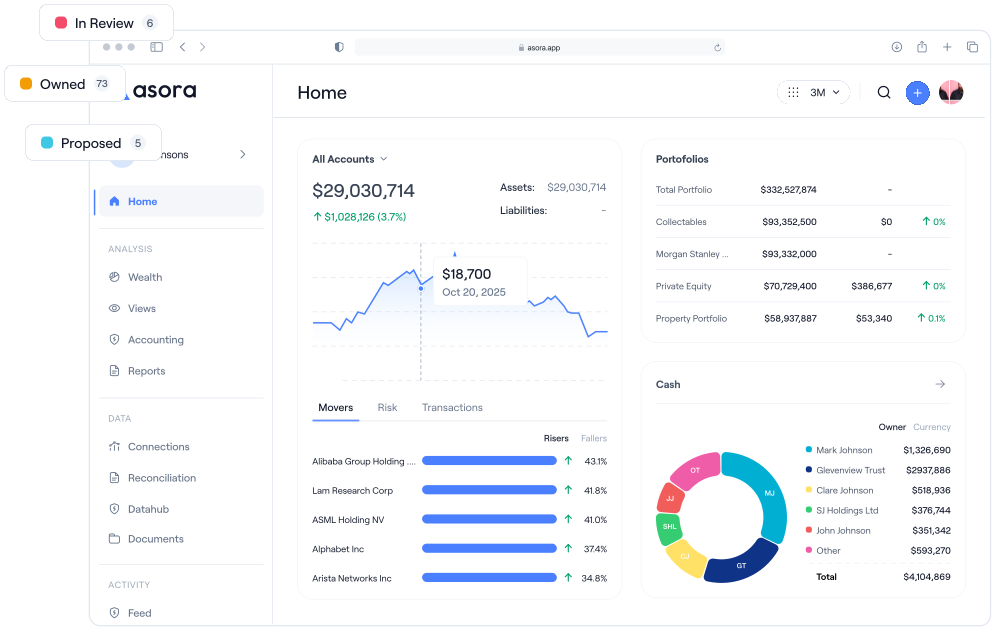
There is no way you would run your operating business on a spreadsheet, manually pulling data. You need a proper information system for your wealth too. Maybe it is not your core job, maybe it is seconded, but you still need to manage it properly. That is what Asora is.
And the spreadsheet is never finished. At the start there is almost nothing in it. Then it gets more, and more, and more, until pulling the reporting together is a job in itself. The fix is to automate the data gathering so the file stops growing and the monthly close stops hurting.
Five mistakes embedded CFOs make when picking software
- Buying enterprise software built for a five-person back office. It looks impressive in the demo, then you spend eight weeks onboarding and use a fraction of it, because it assumes a team you do not have.
- Stretching the company's accounting system to hold personal wealth. The chart of accounts gets contaminated, the audit gets harder, and the owner still cannot read the report. The business system was never meant to track a family.
- Staying on Excel until you hire someone. The errors creep in quietly. A capital call slips, and there is no trail when the owner asks about a deal from two years ago. You would never run the company this way, so do not run the wealth this way either.
- Picking something that cannot grow past the liquidity event. If the platform tops out at embedded scale, you end up re-platforming right after a sale, when everyone is already stretched and the data matters most.
- Buying a platform that needs a principal user the founder will never log into. If the design assumes the owner is in there every week, you become their data-entry clerk, which is the opposite of the point.
The thread running through all five is the old way of building a family office: hire people first, then figure out the systems. The trouble is you cannot attract good people to do manual data collection, and if you do, you are burning them on work software should handle. So you get the order wrong from the start.
How to evaluate family office software when you are the embedded CFO
If you keep one list from this piece, keep this one. Good family office software for an embedded CFO should:
- be runnable end to end by one person, with no requirement for an operations team
- go live in weeks, not months
- pull your liquid accounts automatically and still hold the private, illiquid assets
- sit alongside your operating-company accounting, not try to replace it
- produce a report the founder can actually read, not an institutional dashboard
- grow from embedded scale to a full single family office without a rebuild
- come with real human support, not a chatbot
- ship with off-the-shelf guidance and prebuilt reports for real estate, private equity and quarterly performance, so you are not inventing family office reporting from scratch
- price for the wealth you track, not punish you for adding a family member as a view-only user
The order of operations is the part most people get backwards. The old way was to hire a person first. The better way now is to put the software in first, get the data and reporting running with automation, and only then add people, for the valuable work, never for copying numbers between four portals. That also lets the role grow: wealth reporting is not your specialism, so let the platform guide you with the prebuilt structures rather than learning it the hard way.
Whatever you choose, the first real milestone is the same. Get the whole picture into one place: every asset, every owner, every entity, every account. Once your net worth is crystallised in a single system, everything else has something to build on. When you are ready to compare options, our 2026 family office software guide lays out the shortlist.
When the embedded CFO becomes the family office CFO
The day the company sells, or the day the next generation joins the conversation, the embedded setup usually stops fitting within a few months. The good news is that none of the work you did is wasted, as long as the software you chose was built to carry you across that line. The platform you ran on the side becomes the platform the real office runs on, with the same data, the same history, and no fire drill.
If a sale or a handover is on the horizon, it is worth getting the structure in early rather than in the rush. Talk to Adam about whether Asora fits your embedded setup.
 ISO 27001 Certified
 GDPR Compliant