
As wealth passes from one generation to the next, many families set up a family office to run their affairs in one place. But "family office structure" means two different things at once, and mixing them up is where most families go wrong. This guide separates the two, backs the numbers with named sources, and shows you how to choose.
TL;DR
A family office structure has two layers. The operating model is how the office is staffed: a single-family office (SFO) for one family, a multi-family office (MFO) for several, or a virtual family office (VFO) that outsources most of the work. The legal structure is the wrapper: the entities that hold the assets and the country they sit in. Which model you pick turns on wealth, control and privacy. Which wrapper you pick turns on tax, protection and where the family lives.
Key takeaways
- The three operating models are the SFO (one family, full control, highest cost), the MFO (many families, shared cost), and the VFO (lean core, outsourced specialists).
- A single-family office usually needs about $100M+ to justify its cost (Deloitte), with industry consensus putting the threshold in the $100M to $250M range (Morgan Lewis, 2026).
- The average family office runs at about $3M a year, rising to $6.6M for offices above $1B in assets (J.P. Morgan, 2026).
- There are about 8,030 single-family offices worldwide, set to reach 10,720 by 2030 (Deloitte).
- The legal wrapper and its jurisdiction matter as much as the model, from US trust states like Delaware and South Dakota to international hubs such as Singapore, Switzerland and Ireland.
What is a family office structure?
A family office structure is the way a wealthy family organises the people, entities and technology that manage its wealth. It has two parts: the operating model that decides who does the work, and the legal structure that decides how the assets are owned and where.
Get both right and you have a system that grows and protects wealth across generations. Get either wrong and you either overpay for a team you do not need, or you house the assets in the wrong entity in the wrong country and pay for it at tax time. The rest of this guide takes each layer in turn.
The three family office structures at a glance
The short version: an SFO is your own private firm for one family, an MFO is a shared firm serving many families, and a VFO is a small core team that buys in everything else. The table sets them side by side. The thresholds are rules of thumb, not rules; the $100M single-family floor is the one with solid sourcing.
| Model | Who it serves | Typical minimum | Cost model | Control | Privacy | Best for |
|---|---|---|---|---|---|---|
| Single-family office (SFO) | One family | ~$100M+ (often $250M+) | Runs its own costs, ~$1M to $6M+ a year (~35 to 45 bps of AUM) | Full | Highest | Families with the scale and will to run a firm |
| Multi-family office (MFO) | Several families (often 10 to 50) | ~$25M+ | A fee, roughly 0.5% to 1.5% of assets | Shared | Strong | Families wanting institutional service without the overhead |
| Virtual family office (VFO) | One family, outsourced | ~$10M to $100M | Lean retainer plus outsourced fees | High | Depends on tooling | Smaller or newer offices that prefer software to payroll |
Sources and caveats: the $100M SFO benchmark is from Deloitte (citing Harvard Business Review). Cost ranges are from J.P. Morgan 2026 and UBS 2025, listed in full under Sources at the end. MFO and VFO minimums are practitioner rules of thumb, not survey figures.
Single-family office (SFO) structure
A single-family office is a private company that manages one family's wealth and answers only to that family. It hires its own team, sets its own strategy, and shares nothing with outsiders. That control is the whole point, and the cost is the price of it.
Who it is for, and what it costs
A single-family office starts to make sense from around $100 million in investable assets, the level Deloitte cites as the benchmark to justify the cost. Many advisers set the bar higher, at $250 million or more, before a full standalone team is efficient. Below that, the fixed cost of staff and systems eats too much of the return.
The running cost is real. J.P. Morgan's 2026 Global Family Office Report puts the average family office operating cost at about $3 million a year, rising to about $6.6 million for offices with more than $1 billion in assets. As a share of assets, UBS found costs averaged about 41 basis points in 2025, falling to about 35 basis points for the largest offices, which enjoy scale. For a smaller office of around $250 million, benchmarking work suggests running costs can still top $1 million a year. None of these figures include the outside investment managers a family pays on top.
Roles and reporting lines
A full SFO looks like a small firm. The family, through a family council or board, sets direction and values. A CEO or director runs the office day to day. Reporting into that role sit the core functions:
- Chief investment officer (CIO): runs the portfolio and the investment team. Typically among the highest-paid roles, and usually the top investment professional.
- CFO and controller: own finance, accounting, cash and reporting.
- General counsel: covers legal, tax and compliance, often with outside firms.
- COO and a technology lead: appear in larger offices to run operations, data and cyber security.
Most offices stay lean. UBS found the average family office employs about 12 people, and most employ 10 or fewer. Personnel is the single largest cost line in almost every office.
Multi-family office (MFO) structure
An MFO gives several families the same service an SFO provides, while sharing the cost across all of them. You get a professional team and institutional tools without hiring anyone yourself, in exchange for less day-to-day control.
An MFO commonly serves anywhere from about 10 to 50 families, though the number varies widely. Each gets a relationship manager and access to shared specialists, and pays a fee, commonly quoted at 0.5% to 1.5% of assets, though the sourced total-cost figures run higher once outside managers are included. Because the firm serves others, it protects each family with information barriers rather than the total privacy of a single-family office. For a full side-by-side, see our guide to the single-family office versus the multi-family office.
Virtual family office (VFO) structure
A VFO keeps a small in-house core and outsources the rest, held together by software instead of a large payroll. It suits families who want coordination and a single view of their wealth without the cost of a full team.
A virtual family office might be one or two trusted people plus outside investment, tax, legal and reporting providers, all working off one shared platform. It is the natural entry point for families in the $10 million to $100 million range, and a sensible stepping stone before a family builds out a full SFO.
How much wealth do you need for each?
As a rule of thumb: a virtual or multi-family office suits families from about $10 million to $25 million, and a single-family office starts to make sense from about $100 million, with many advisers pointing to $250 million before a full team pays for itself. These are guides, not gates. A family with unusual complexity might build sooner. A simpler family with more wealth might happily stay with an MFO.
Minimum net worth by structure, rule of thumb
- $10M to $30M: a virtual family office or a multi-family office. You get coordination and service without the cost of a team.
- $30M to $100M: a multi-family office is the usual home; a VFO works for the tech-minded.
- $100M to $250M: a single-family office becomes viable. The choice turns on control and privacy, not just cost.
- $250M and up: a full standalone single-family office is efficient, and control is often the deciding factor.
The $100M single-family benchmark is sourced (Deloitte, citing Harvard Business Review). The MFO and VFO figures are practitioner rules of thumb.
What a family office costs to run
A single-family office often costs $1 million or more a year to run, and averages about $3 million across all offices (J.P. Morgan, 2026). A multi-family office charges a fee, commonly 0.5% to 1.5% of assets. At the same level of wealth the shared model is usually cheaper, because the cost is spread across families. The example below is illustrative and covers the cost of running the office only. It excludes the third-party investment managers both models pay on top, which Cambridge Associates puts at a further 75 to 105 basis points for a large family.
| Annual cost for a family with ~$250M | Single-family office | Multi-family office |
|---|---|---|
| In-house team (CIO, CFO, analyst, admin) | $700k to $1.4M | Included in the fee |
| Office, technology, legal, audit | $300k to $700k | Included in the fee |
| Total to run the office | ~$1M to $2M | ~$1.25M to $2.5M (0.5% to 1% of $250M) |
| As a share of assets | ~0.4% to 0.8% | ~0.5% to 1% |
| Third-party investment managers | Paid on top | Paid on top |
The numbers sit close at $250 million, which is exactly why control and privacy, not cost alone, tend to decide it at that level. Below $100 million the sums move firmly towards the shared models, because the fixed cost of an in-house team is spread over too little wealth.
Legal structures for a family office
The operating model decides who does the work. The legal structure decides how the assets are owned. Most offices use a mix: an operating company for the office itself, and separate holding entities and trusts for the assets. The table below covers the common wrappers. In the US, a qualifying single-family office also sits outside the SEC's definition of an investment adviser under its 2011 family office rule, often called the family office exemption, so it does not have to register.
| Legal structure | What it is for | Liability | Tax treatment | Best use |
|---|---|---|---|---|
| LLC | The operating entity for the office | Strong | Pass-through or elective | The default wrapper for most single-family offices |
| Limited partnership (LP / FLP) | Pooling family capital and passing value on | Strong for limited partners | Pass-through | Internal private-equity arms; moving value to the next generation while keeping control |
| Trust | Owning assets for estate planning and protection | Very strong | Grantor or non-grantor | Multi-generational transfer and creditor protection |
| Private trust company (PTC) | A family-owned entity that acts as its own trustee | Strong | Varies | Large families with many trusts wanting continuity and control |
| Foundation | Ownership and governance where trusts are not recognised | Strong | Varies | Civil-law countries such as Switzerland, Liechtenstein and the UAE, and philanthropy |
Where family offices are based
Jurisdiction shapes a family office as much as the entity does, because it drives tax, protection and reporting. This is the part most guides skip. The choice splits between where the office is run and where the assets are held, and the two are often different countries.
In the United States, families choose trust-friendly states for the assets. Delaware, South Dakota, Nevada, Wyoming and Alaska lead. They allow long-lasting "dynasty" trusts, though the limits differ: perpetual in Delaware and South Dakota, up to 1,000 years in Wyoming, and 365 years in Nevada. They also bring strong asset protection, privacy and, in several states, no state income tax.
Internationally, Switzerland, Luxembourg, the UK, Singapore, Dubai and Ireland have all become strong bases. Each has its own draw:
- Singapore runs formal tax-incentive schemes through the Monetary Authority of Singapore. The 13O scheme requires S$20 million in designated investments; the 13U scheme requires S$50 million in designated investments and higher local spending.
- Switzerland exempts most single-family offices from investment-firm licensing where family ties are met, and makes wide use of foundations for governance.
- The United Kingdom replaced its long-standing non-dom regime with a four-year "foreign income and gains" regime for new residents from 6 April 2025, changing the calculus for families moving there.
Ireland and the EU
Ireland features in many European family-office structures, mostly on the investment side. Irish and Luxembourg vehicles together hold about 91% of Europe's cross-border fund assets, with Ireland at 43%, and Ireland is the largest ETF domicile in Europe, home to about 78% of European ETFs. It combines a 12.5% corporate tax rate, treaties with more than 75 countries, and vehicles built for the job:
- The ICAV (Irish Collective Asset-management Vehicle), introduced in 2015, is a corporate fund vehicle authorised by the Central Bank of Ireland. It carries an entity-level tax exemption on investment returns, no withholding tax on payments to non-resident investors, and, unlike an Irish plc, it can "check the box" for US tax purposes, which matters to families with US connections.
- The Investment Limited Partnership (ILP) is a tax-transparent partnership used for private-market strategies.
- The Section 110 SPV is an Irish company used, often alongside an ICAV, as a tax-neutral conduit for holding financial assets.
Get advice before you build
Entity and jurisdiction choices depend on where the family lives, where its assets sit, and its tax position. The structures above are the landscape, not a recommendation. Work them through with qualified legal and tax advisers before you set anything up.
How to choose the right structure
Work the two layers in order. First choose the operating model from wealth, complexity, control and privacy. Then choose the legal wrapper and base with your advisers. A short way to filter the model:
- Choose an SFO if you have roughly $100M or more, want full control and maximum privacy, and are willing to run a small firm.
- Choose an MFO if you want a full bench of specialists on day one, will delegate the day-to-day, and would rather pay a fee than a payroll.
- Choose a VFO if you are earlier in the journey, value a single clean view over a large in-house team, and want to keep the option to build later.
The decision is not permanent. Many families start with a multi-family or virtual office and build a single-family office as wealth grows. If you are moving from model to model, our guide on how to start a family office walks through the steps.
The layer under every structure
Whatever model and entity you choose, the structure only works if the numbers are right. An SFO with total control still fails if its data lives in a dozen spreadsheets. An MFO serving fifty families cannot report clearly if every custodian feed looks different. And a structure spread across several entities, currencies and countries is impossible to see whole without one system pulling it together.
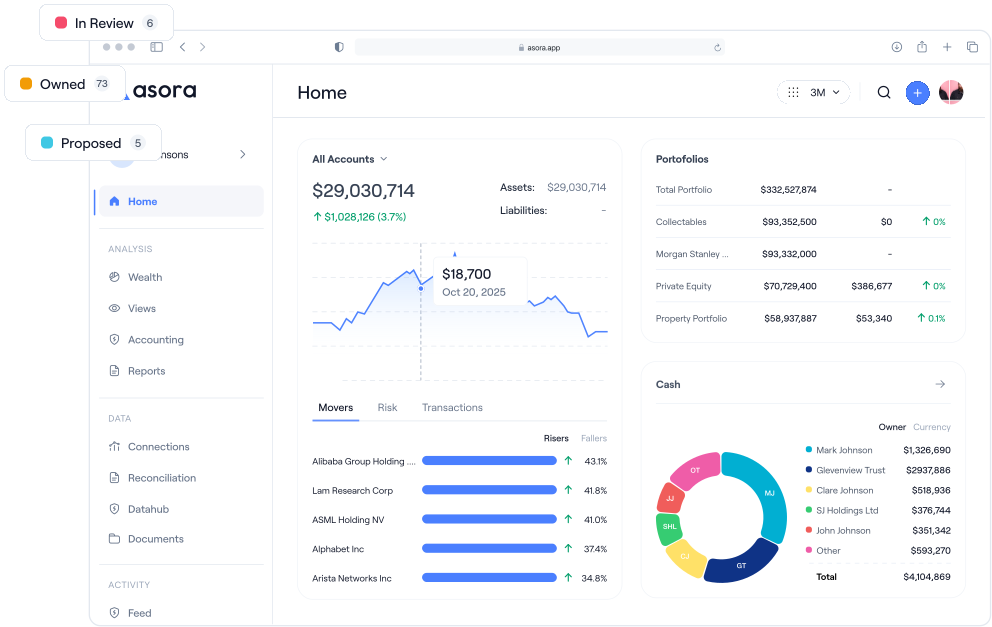
That is the job Asora does. It consolidates every account, entity, currency and asset class, public and private, into one live view, so the family and its advisers see the whole position at once, across the whole structure. Clean, consolidated reporting is what turns a legal diagram into something a family can actually run.
Sources
- Deloitte Private, Family Office Insights Series, Global Edition (2024) and Setting up a family office (2024): family-office counts, growth to 2030, the $100M benchmark, roles and the SEC exemption.
- J.P. Morgan Private Bank, 2026 Global Family Office Report: average operating cost ($3M, $6.6M for $1B+), governance (83%).
- UBS, Global Family Office Report 2025: cost in basis points and average team size.
- Cambridge Associates, A Wealth Management Cost Framework for Families: total cost breakdown for a $500M family.
- PwC, Global Family Office Location Guide (May 2025): jurisdictions, entities and foundations.
- Monetary Authority of Singapore, family office tax-incentive schemes: 13O and 13U thresholds.
- J.P. Morgan, A Tale of Two Domiciles and Matheson, Ireland as an International Fund Domicile (2025): Ireland and EU fund vehicles.
- US SEC, Family Office Rule (IA-3220, 2011): the exclusion of family offices from investment-adviser registration.
- Northern Trust, Specialized Trusts: A Side-by-Side Comparison of States: US dynasty-trust duration rules by state.
- Morgan Lewis, Modernizing the Family Office (2026): the $100M to $250M single-family-office threshold consensus.
FAQ
What is a family office structure?
A family office structure has two layers. The first is the operating model: a single-family office (SFO) serves one family, a multi-family office (MFO) serves several, and a virtual family office (VFO) runs a lean core with outsourced specialists. The second is the legal wrapper: the entities, such as an LLC, partnership or trust, and the country the office and its assets are based in.
What are the three types of family office?
The single-family office (SFO), the multi-family office (MFO), and the virtual family office (VFO). An SFO gives one family full control and privacy at the highest cost. An MFO shares a professional team and its cost across many families. A VFO keeps a small in-house core and buys in the rest, held together by software.
How much money do you need for a family office?
A common benchmark is $100 million in investable assets to justify a single-family office (Deloitte), and many advisers point higher, to $250 million or more, before a full standalone team pays for itself. A multi-family office is open from roughly $25 million, and a virtual family office can suit families from about $10 million. Treat the MFO and VFO figures as rules of thumb, not hard limits.
What does a family office cost to run?
J.P. Morgan's 2026 Global Family Office Report puts the average annual operating cost at about $3 million, rising to about $6.6 million for offices with more than $1 billion in assets. As a share of assets, UBS found running costs averaged roughly 41 basis points in 2025, and about 35 basis points for the largest offices. These figures exclude the third-party investment managers a family still pays on top.
What legal structure do family offices use?
The most common operating wrapper is a limited liability company (LLC). A limited partnership pools family capital and helps pass value to the next generation. Trusts hold assets for estate planning and protection. Large families with many trusts sometimes set up a private trust company to act as their own trustee. In civil-law countries, foundations do a similar job to trusts.
Where are family offices based?
Common bases include US trust-friendly states such as Delaware and South Dakota, and international hubs such as Switzerland, Luxembourg, the UK, Singapore and Ireland. Ireland is widely used for the investment side: Irish and Luxembourg vehicles hold about 91% of Europe's cross-border fund assets, and Ireland is the largest ETF domicile in Europe. The right base depends on the family's residence, assets and tax position, and needs qualified advice.
What roles are in a family office?
A full office is led by a CEO or director, with a chief investment officer (CIO) running the portfolio, a CFO and controller handling finance and reporting, and a general counsel covering legal and tax. Larger offices add a COO and a technology lead. UBS found the average family office employs about 12 people, and most employ 10 or fewer.
How is a family office governed?
Through a mix of a family council or board that sets direction and values, an investment committee that oversees the portfolio against an investment policy statement, and clear reporting to the family. J.P. Morgan found 83% of family offices have formal governance structures in place, most often an investment committee, an investment policy statement, or a board.
.png)
.png)
.jpg)
 ISO 27001 Certified
 GDPR Compliant