Asset Allocation Template for Family Offices (Free Download)
Track allocation, spot drift, decide

Asset Allocation Template for Family Offices (Free Download)
TL;DR
This asset allocation template helps family offices build a clearer working view of portfolio exposures across the assets, entities, and accounts included in the review. Use it to document investment objectives, portfolio constraints, liquidity requirements, spending needs, time horizon, risk parameters, and target allocation across defined asset categories, then compare current exposures with policy and track what needs to change. The download is a spreadsheet-based asset allocation worksheet and strategic asset allocation template, built to support periodic review, often quarterly. It includes predefined asset class categories that can be customized to fit the office's own allocation framework.
Why Family Offices Need an Asset Allocation Template
For many family offices, asset allocation decisions and data are spread across spreadsheets, custodian portals, manager reports, private fund statements, administrator reports, and email threads. That makes it harder to see the full portfolio clearly, harder to explain drift from policy, and harder to know what actually needs to change.
A good asset allocation template creates one working view of the portfolio exposures being tracked, based on the office's chosen scope, classification rules, and valuation inputs. It gives you a practical way to record investment objectives, portfolio constraints, liquidity needs, spending requirements, and target allocation policy across major asset classes, then compare those targets with current exposures in a format that is easy to review and update.
This is especially useful for multi-entity portfolios where public markets, private funds, direct investments, real assets, and cash reserves need to be viewed in one consistent framework, even though valuation timing and data quality may differ across asset types. It can also support a shared reference point for internal staff and selected external stakeholders, such as trustees, advisors, or outsourced investment partners, depending on the office's governance model and information-sharing protocols.
What This Asset Allocation Template Helps You Do
This template is designed to help a family office:
- Record target allocation across major asset classes
- Track current exposure against policy
- See where reported allocations have drifted from policy, subject to the valuation timing and look-through available for each asset type
- Identify what may need to change
- Document temporary deviations from strategic policy, along with rationale, approval, and review date
- Keep a clear change history over time
Why The Download is a Spreadsheet
Asset allocation is a strategic and iterative exercise. A static PDF is not a very practical format for something that needs to be updated regularly, compared against the latest available exposure data, and used in ongoing review.
That is why this template is built as a spreadsheet. It is easier to update, easier to maintain, and better suited to quarter-on-quarter monitoring.
The structure is designed to give you:
- Predefined asset classes
- Target percentages by category
- Current exposure by category
- Variance versus target
- Basic rebalancing indicators for further review
- A change log for documented updates
What's Inside the Asset Allocation Template
The download includes:
What's Inside
- Portfolio objectives and constraints: a place to record investment objectives, liquidity requirements, spending needs, concentration limits, time horizon, and risk parameters
- Strategic allocation table: predefined asset classes with target percentages and review bands
- Current exposure view: a working section to record the latest available allocation and compare it against the target allocation
- Drift and action tracker: a simple way to flag exposures outside target ranges or outside approved temporary exceptions, and note what may need review
- Short-term tilt tracker: a place to record temporary allocation deviations and their rationale
- Periodic review view: a structure designed for repeated review over time, whether monthly, quarterly, or event-driven
- Change log: a clean record of what changed, when, and why
What the Spreadsheet Tracks
The template is designed to help family offices track allocation policy and latest available reported exposures.
That includes:
- Target allocation by asset class
- Current allocation by asset class
- Variance versus target
- Band status
- Actions or follow-up notes
- Quarter-on-quarter changes
Who This Template Is For
This template is built for family offices, particularly those managing multi-entity portfolios, especially where exposures span public markets, private assets, and liquid reserves.
It is a good fit for:
- Single-family offices
- Multi-family offices adapting the framework for clients
- Family offices with alternative-heavy allocations
- Teams that need a clearer way to track allocation over time
- Principals, CIOs, trustees, and advisors who want a clearer reference view of portfolio allocation
What It Does Not Try To Do
This template does not try to replace a full Investment Policy Statement or any broader governance document used to set investment guidelines, generate investment advice, or automate trade execution.
It is there to help you:
- Document the allocation framework or policy ranges already approved elsewhere
- Compare current exposures with the desired allocation
- Track drift more clearly
- Support better portfolio review
How Family Offices Typically Use It
Many teams will use the spreadsheet during their regular portfolio review cycle, often quarterly, to update exposure figures and assess alignment with policy.
A family office may use it to summarise public equities, fixed income, cash, private funds, direct investments, and real estate in one review framework. Others may use it as a simpler form of strategic asset allocation review before updating an IPS, investment committee materials, or other internal governance documentation.
For example, some offices use it to review where relevant, whether the taxable portion of the portfolio has moved too far from policy, whether enough cash is available for spending distributions, taxes, debt service, or capital calls, or whether a heavy concentration in one sleeve has changed the intended balance of the whole portfolio.
Some families also use it to keep a clearer view of how the portfolio supports spending, distributions, liquidity, and longer-term priorities such as philanthropy, succession planning, intergenerational wealth transfer, or strategic family commitments.
Where Asora Fits
Asora fits on the portfolio monitoring and reporting side of this process, rather than on the advice, policy-setting, or trade execution side.
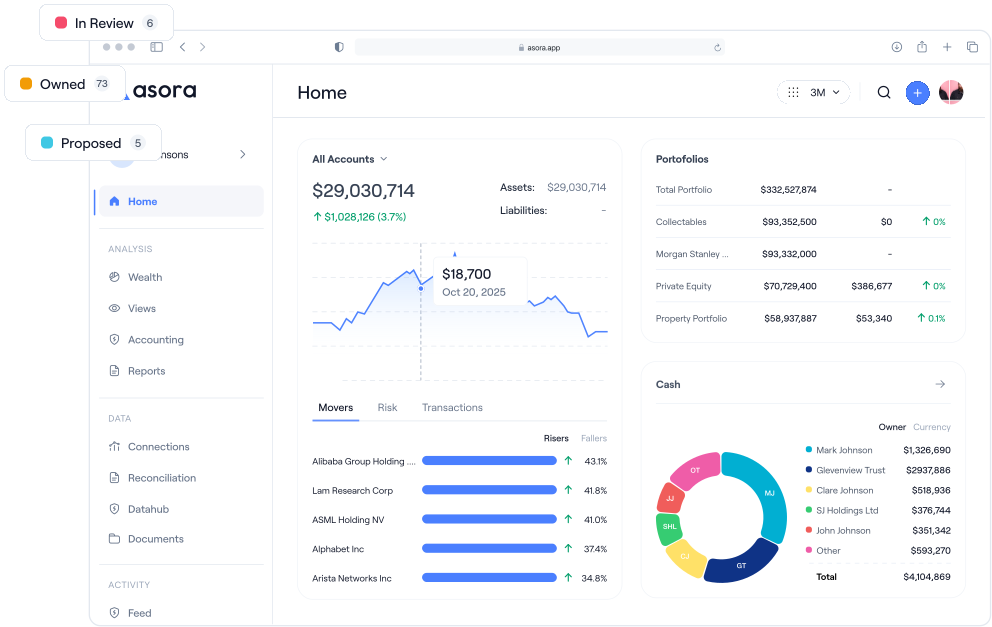
It can help family offices track consolidated reported asset weights across entities, include private asset exposures in the allocation review process, and connect allocation oversight to broader reporting, subject to source data coverage and valuation timing. That makes it easier to maintain a current view of the portfolio and use the allocation framework more consistently over time.
For family offices managing several entities, pools of capital, or private holdings, this can improve access to more consistent, consolidated reporting inputs and make the quarter-on-quarter process easier to run.
Download the template
Complete the fields, then export or print for review and diligence.
FAQ
What is an asset allocation template?
An asset allocation template is a structured tool used to document target allocation, latest available exposures, and reported drift across the portfolio. It helps family offices compare policy with reality in a format that is easy to update over time.
Why is this template a spreadsheet instead of a PDF?
Because asset allocation review is ongoing rather than static. It changes over time, and it is easier to manage in a spreadsheet that can be updated quarter on quarter.
What does the asset allocation template include?
It includes predefined asset classes, target percentages, current exposure tracking, rebalance bands, short-term tilt tracking, and a change log.
Can this work for alternative-heavy portfolios?
Yes, but with caveats. It can support alternative-heavy portfolios where the office has a workable method for recording reported valuations, commitments, unfunded obligations, and liquidity assumptions, even if some private asset data is estimated or lagged.
Does this replace an Investment Policy Statement?
No. It works best as a practical allocation tracking and review tool alongside an IPS or other approved governance documentation.

![Family Office Investment Reporting Template [Free Download]](/_next/image?url=%2Fimages%2Ftemplates%2Fcovers%2Finvestment-reporting.png&w=3840&q=75&dpl=dpl_4VpEsk7SUXYyQc8Ek9e7V2svTfzf)
![Family Office RFP Template [Free Download]](/_next/image?url=%2Fimages%2Ftemplates%2Fcovers%2Ffamily-office-rfp.png&w=3840&q=75&dpl=dpl_4VpEsk7SUXYyQc8Ek9e7V2svTfzf)

![Family Office Tech Stack Template [Free Download]](/_next/image?url=%2Fimages%2Ftemplates%2Fcovers%2Ffamily-office-tech-stack.jpg&w=3840&q=75&dpl=dpl_4VpEsk7SUXYyQc8Ek9e7V2svTfzf)
![Family Office Portfolio Management Template [Free Download]](/_next/image?url=%2Fimages%2Ftemplates%2Fcovers%2Fportfolio-management.png&w=3840&q=75&dpl=dpl_4VpEsk7SUXYyQc8Ek9e7V2svTfzf)
![Family Business Succession Planning Template [Free Download]](/_next/image?url=%2Fimages%2Ftemplates%2Fcovers%2Fsuccession-planning.png&w=3840&q=75&dpl=dpl_4VpEsk7SUXYyQc8Ek9e7V2svTfzf)

 ISO 27001 Certified
 GDPR Compliant