.png)
TL;DR
Family office governance requires clear decision-making processes, defined roles and responsibilities, and formal communication structures like family councils. Strong governance frameworks help family members navigate complex wealth management decisions while preserving family values and preparing future generations for leadership.
You've built major wealth, but now you're facing a challenge that money alone can't solve: how do you make decisions as a family when millions (or billions) are at stake? How do you prevent wealth from dividing your family instead of uniting it?
This is where family office governance becomes important. Without proper governance structures, even the most successful families can struggle with decision-making conflicts, unclear responsibilities, and communication breakdowns that threaten both family unity and financial success.
Family office governance isn't just corporate bureaucracy applied to families—it's the foundation that determines whether your wealth strengthens family bonds or creates lasting divisions.
What Is Family Office Governance?
Family office governance encompasses the systems, processes, and structures that guide how families make decisions about their wealth. It creates the framework through which family members (whether part of a single-family office or multi-family office) interact with their wealth, define roles and responsibilities, and ensure accountability across all family office activities.
Think of it as the "rules of the game" for your family's wealth management and succession planning. Just as successful businesses need governance structures to function effectively, family office teams require clear frameworks to navigate complex decisions involving multiple generations, diverse interests, and significant assets.
Why Governance Structure for Family Offices Matter More Than You Think
Without proper governance structure and a family charter for a single-family office, you'll likely encounter these common problems:
- Decision paralysis when family members can't agree on investment strategies
- Generational conflicts between older and younger family members with different values
- Unclear authority leading to confusion about who can make what decisions
- Communication breakdowns that leave family members feeling excluded or uninformed
- Succession crises when leadership transitions aren't properly planned
Strong family governance prevents these issues by establishing clear processes that everyone understands and trusts.
Family Office Governance Models: Finding What Works
Many family offices use some form of family council as their primary governance structure. A family council brings together family members to discuss strategic issues, review performance, determine goals, and make important decisions together.
What makes family councils work:
- Regular structured meetings (quarterly or semi-annually)
- Clear agendas focused on strategic issues
- Representation from different generations and family branches
- Professional facilitation when needed
- Formal documentation of decisions and action items
Larger family offices (family enterprises) often adopt corporate governance principles, borrowing from corporate best practices to create formal oversight structures. This might include:
- Investment committees that oversee portfolio decisions
- Audit committees that ensure financial transparency
- Compensation committees that handle family employment and compensation
- Independent board members who provide objective perspectives
Family Office Governance Best Practices
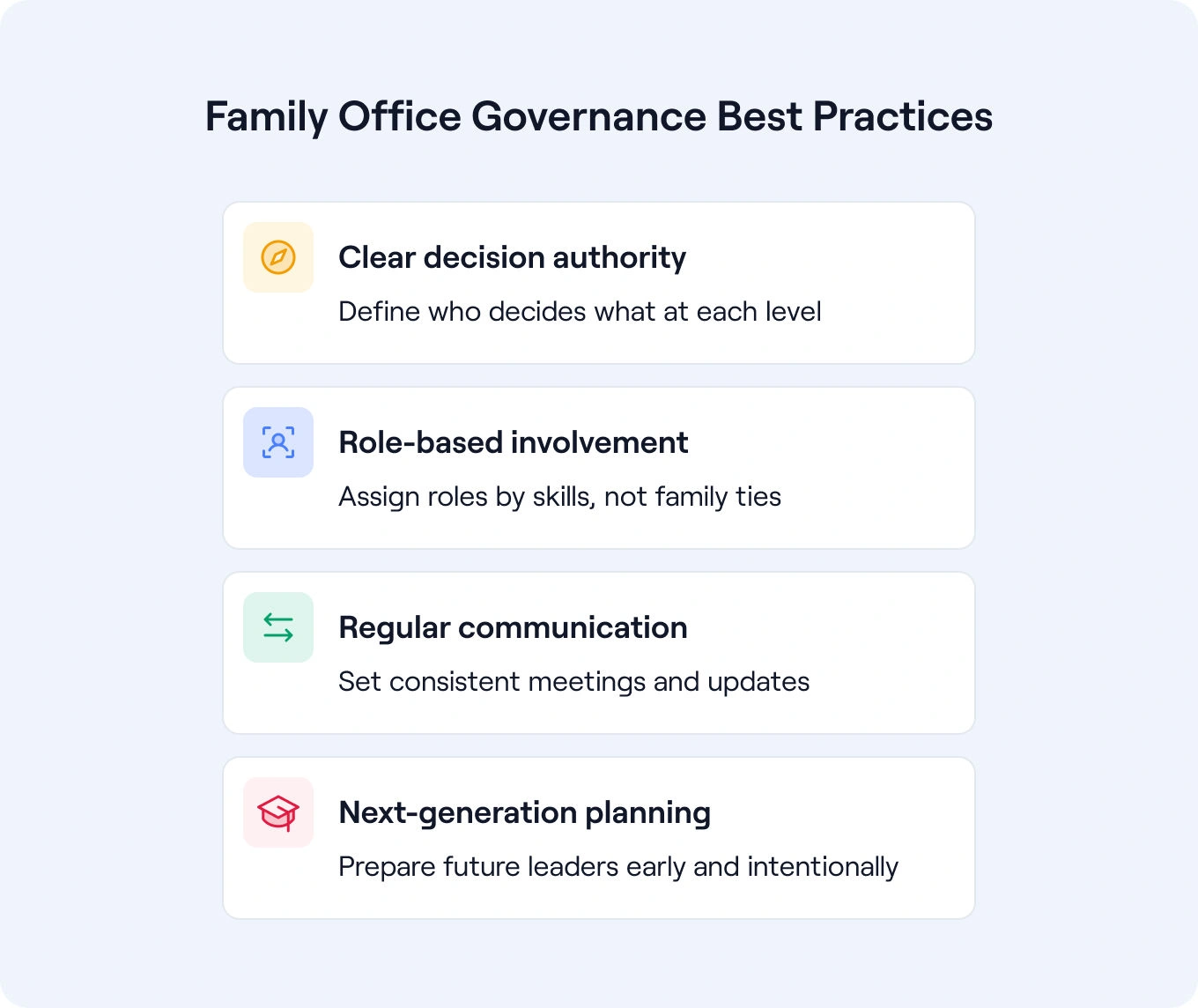
1. Start with Clear Decision-Making Authority
The biggest source of family office conflicts is unclear decision-making authority. Who can approve investments? Who hires and fires staff? Who sets the family's philanthropic strategy?
Create decision-making tiers:
- Operational decisions ($0–$100K): Professional staff authority
- Tactical decisions ($100K–$1M): Family office leadership with family notification
- Strategic decisions ($1M+): Full family council approval required
2. Define Roles Based on Competence, Not Just Bloodlines
One of the hardest aspects of family governance is balancing family involvement with professional competence. Not every family member wants to (or should) be involved in day-to-day wealth management.
Family member roles might include:
- Active participants: Serve on boards, lead committees, take operational roles
- Engaged beneficiaries: Participate in family gatherings, provide input on major decisions
- Passive beneficiaries: Receive distributions and updates but prefer minimal involvement
3. Establish Communication Rhythms
Poor communication kills more family offices than poor investment performance. Establish regular rhythms that keep everyone informed and engaged:
- Quarterly family meetings for strategic updates and major decisions
- Annual family assemblies for comprehensive reviews and succession planning
- Regular written updates on performance and operational matters
- Emergency protocols for urgent decisions
4. Plan for the Next Generation
Sustainable family office governance requires preparing future generations for leadership roles. This isn't just about financial education—it’s about developing governance skills, leadership capabilities, and commitment to family values.
Next generation development includes:
- Mentoring relationships with senior family members
- Gradual assumption of governance responsibilities
- External education and professional development
- Exposure to family office operations and decision-making
Common Governance Challenges (And How to Solve Them)
.webp)
Challenge 1: Generational Differences
Different generations often have varying perspectives on everything from investment risk to social responsibility. These differences can paralyse decisions if not managed well.
Solutions:
- Develop dialogue opportunities between generations
- Establish clear voting procedures when consensus can't be reached
- Develop investment policy statements accommodating different risk tolerances
- Use external facilitators for difficult conversations
Challenge 2: Geographic Dispersion
Modern families are often spread across multiple cities or countries, making traditional governance structures difficult to implement.
Solutions:
- Leverage technology for virtual participation in meetings
- Rotate meeting locations to ensure fair access
- Facilitate regional family councils that feed into overall governance
- Develop robust systems that work across time zones
Challenge 3: Balancing Family and Professional Input
Families need professional expertise to manage complex wealth effectively, but they also want to maintain family control over important decisions.
Solutions:
- Clearly define which decisions require family approval versus professional authority
- Include advisors on family office boards
- Invest in family member education to improve decision quality
- Create advisory roles for professionals to guide decisions without authority
How to Implement Your Family Office Governance Framework
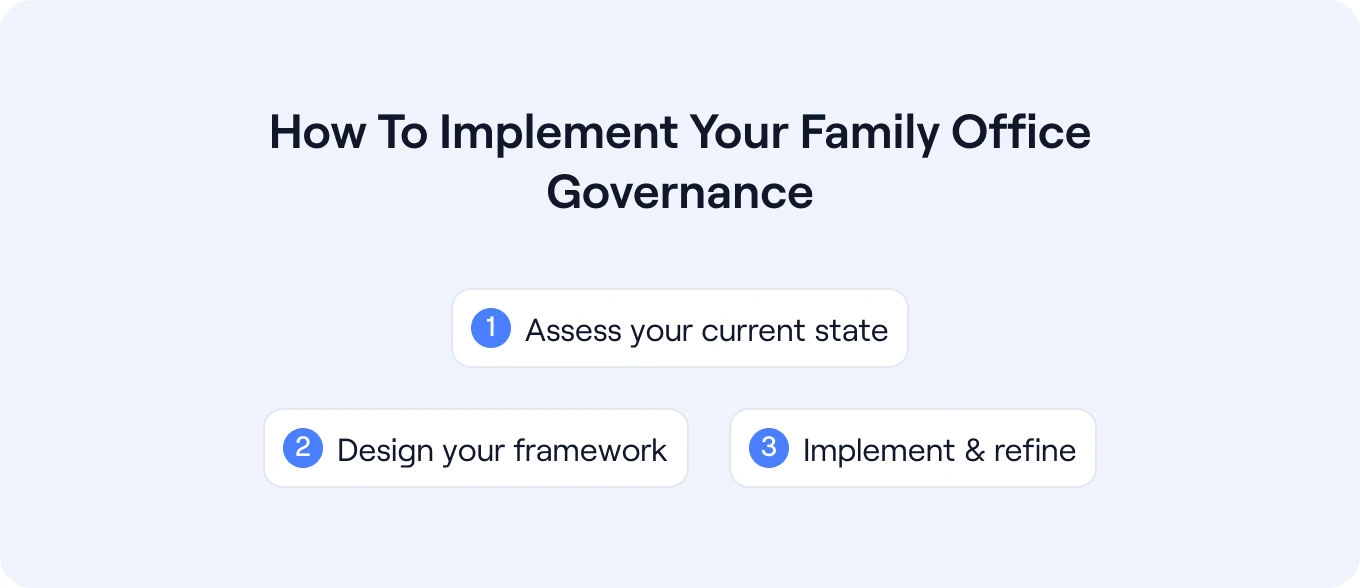
Step 1: Assess Your Current State
Before designing new governance structures, understand what you currently have (formal or informal) and what's working or not working.
Key questions to ask:
- How are important decisions currently made in your family?
- Who participates in these decisions, and who feels excluded?
- What conflicts or confusion have you experienced in the past?
- What are your family's core values and how should they influence governance?
Step 2: Design Your Framework
Based on your assessment, design governance structures that fit your family's needs, goals, and circumstances.
Consider:
- Family size and complexity
- Geographic distribution
- Generational involvement
- Family business complexity
- Family values and culture
- Family’s purpose and legacy
- Strategic goals
- Vision
Step 3: Implementation and Refinement
Start with foundational elements and build more sophisticated structures over time. Governance is iterative and improves through experience.
Implementation tips:
- Begin with informal structures before formalising everything
- Get buy-in from key family members before implementation
- Provide training and support for new governance participants
- Plan for regular reviews and adjustments
Family Office Governance Services: When to Get Help
Many families benefit from professional governance services during key transitions or when developing new structures. External expertise can provide:
- Objective assessment of current governance effectiveness
- Best practice guidance based on experience with other families
- Facilitation services for difficult family conversations
- Implementation support during governance transitions
- Ongoing coaching for family leaders and participants
Professional governance support is especially valuable when establishing new family offices, navigating generational transitions, or dealing with complex family dynamics that affect decision-making.
Technology and Modern Governance
Modern governance frameworks increasingly rely on technology to improve communication, streamline decision-making, and enhance transparency.
- Family-office management software
- Secure communication platforms for family discussions
- Document management systems for governance materials
- Voting and polling systems for family decisions
- Performance dashboards for transparency
- Meeting management tools for family councils
What to Do Next
Successful family office governance doesn't happen overnight, but the investment pays dividends through improved decision-making, reduced conflicts, and better long-term outcomes for both wealth and relationships.
Start by assessing your current arrangements and identifying priorities for improvement. Focus on building foundational elements that can evolve with your family's needs.
Remember: governance is about people and relationships, not just processes. The most sophisticated framework will fail without genuine commitment and shared purpose.
Your family's wealth represents more than financial assets—it embodies values, aspirations, and responsibilities that extend across generations. Strong governance ensures this wealth strengthens family bonds and prepares future leaders for stewardship.
FAQ
What's the ideal size for a family council?
Most effective family councils have 5–12 members—large enough for representation but small enough for productive discussions. Larger families may use multiple councils or a tiered structure with a smaller executive group.
How do we handle family members who don't want to participate?
Respect different participation preferences while ensuring everyone stays informed. Offer multiple engagement levels and don’t force participation, but require basic communication and respect for decisions made through governance processes.
When should we involve independent advisors?
Independent advisors are helpful when specialised expertise or objectivity is needed. Involve them during major transitions, when establishing new structures, or for complex decisions requiring external perspective.
How often should we review our governance structures?
Conduct formal reviews every 3–5 years, with annual check-ins to address issues. Major life events, transitions, or significant family changes should trigger additional reviews.

.png)
 ISO 27001 Certified
 GDPR Compliant